How to Grow Walnut Trees: From Seed to Harvest
How to grow walnut trees from seed or grafted saplings: climate, soil, spacing, pollination, pruning, how long until they fruit, and harvesting.
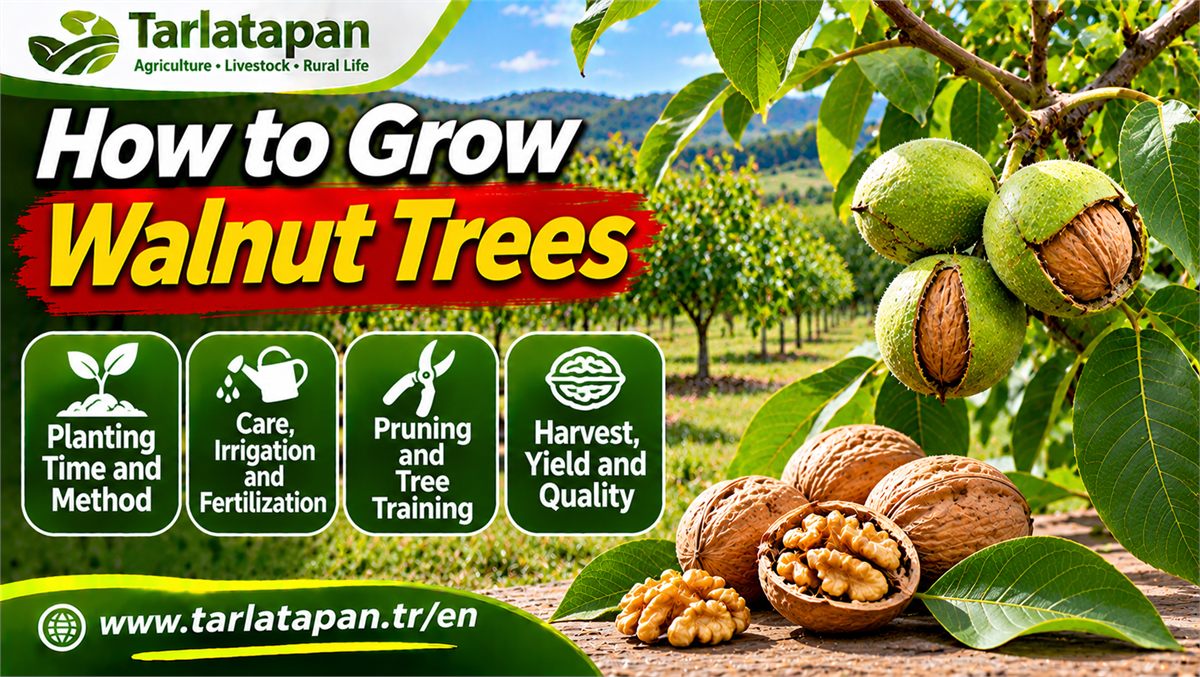
Success with walnut trees is decided by three choices made before the tree goes into the ground: buying a grafted sapling of a named variety, choosing a site where late spring frost does not settle and the water table is deep, and planting at least two compatible varieties for pollination. A grafted walnut usually bears its first nuts about 3 years after planting and reaches full commercial yield in 8–10 years. A tree grown from seed can take 12–15 years and will not be a copy of the tree the nut came from.
This guide walks through every stage of growing walnuts, whether you are planting a single tree in the garden or setting up an orchard.
English Walnut vs Black Walnut: Which One to Grow?
Two species are commonly grown, and they are very different trees:
| English (Persian) walnut | Black walnut | |
|---|---|---|
| Latin name | Juglans regia | Juglans nigra |
| Origin | Central Asia, Caucasus, Anatolia | Eastern North America |
| Shell | Thin, cracks easily | Very thick and hard |
| Flavour | Mild – the walnut sold in shops | Strong, earthy |
| Main use | Nut production | Timber, wild nuts, wildlife |
If you want walnuts to eat or sell, grow the English walnut. Everything below refers to Juglans regia unless stated otherwise.
Walnut Tree Size and Lifespan
The walnut is a large, long-lived tree that can reach 25–30 m (80–100 ft). Its natural lifespan is given as 150–400 years, and it stays productive for around a century. It has a deep taproot: roots go down 2–4 m (6–13 ft) and also spread widely, so plant it well away from buildings, drains and small gardens.
A few features of the walnut shape the whole planting plan:
- It is wind-pollinated and does not need bees.
- Male flowers (catkins) form on last year's wood; female flowers appear at the tips of the current season's shoots.
- On the same tree, male and female flowers often open on different days, so a single variety on its own may set few nuts.
- In-shell walnuts store for a long time, and the trees have fewer pests than most fruit trees – but anthracnose and codling moth can take a large share of the crop if ignored.
Climate Needs and Late Frost Risk
Walnuts are a temperate-climate tree, broadly suited to USDA hardiness zones 5–9. A dormant tree survives winter lows down to about -25°C (-13°F); the real danger is late spring frost:
- Closed buds tolerate about -3°C (27°F).
- Open flowers and small green nuts are damaged at about -1°C (30°F).
- Young shoots that have not hardened off in autumn freeze at -9 to -12°C (16 to 10°F).
Summer heat matters too: temperatures of 35°C (95°F) and above cause sunburn on the green husk, which can cut the crop by up to half in bad years. Varieties need roughly 500–2,000 chill hours (time below 7°C / 45°F) in winter. Avoid frost pockets such as valley floors and hollows where cold air settles.
Soil Requirements and Drainage
Because the roots go deep, walnuts need deep soil. Before planting, check that:
- Soil depth is at least 2 m (6.5 ft).
- The water table stays below 2.5–3 m (8–10 ft). Where it rises higher, trees often die at 5–7 years old.
- Soil pH is around 6–7.
- The soil is not heavy clay (over about 30% clay), salty or very chalky. Low-lying land needs drainage.
For an orchard, have soil samples tested from several depths (0–30, 30–60, 60–90 and 90–120 cm / 0–4 ft) before you commit.
Growing Walnuts from Seed vs Grafted Saplings
Every walnut grown from seed is genetically unique. Even if you plant a nut from an excellent tree, the seedling will not inherit its nut size, kernel ratio or yield.
| Grafted sapling | Seedling (from a nut) | |
|---|---|---|
| First crop | 3–5 years | 12–15 years |
| Nut quality | True to the variety | Unpredictable |
| Kernel ratio | 50% or more in good varieties | Often 30–40% |
| Yield at the same age | Around 50–60% higher | Low and irregular |
| Pollination planning | Possible – varieties are known | Not possible |
Growing from seed is still a fun project for a garden or a rootstock. Use fresh, unroasted nuts in their shells (shop-bought nuts are often too old or heat-treated to sprout). Walnuts need a cold, moist period before they germinate: either plant them outdoors in autumn about 5 cm (2 in) deep, or keep them in damp sand in the fridge for around 3–4 months and sow in spring. Protect the seeds from squirrels and mice with wire mesh.
For nuts, always buy a grafted, named and certified sapling from a reputable nursery, with the variety written on the receipt.
When and How to Plant Walnut Trees
Plant bare-root saplings while they are dormant. Where winters are harsh, plant in early spring as soon as the soil can be worked; in mild climates, late autumn to early winter planting lets roots settle before growth starts. In the Southern Hemisphere (Australia, New Zealand, South Africa, South America) this window falls roughly between May and August.
- Dig a hole about 60 × 60 cm (2 × 2 ft).
- Set the tree so the graft union stays above soil level.
- Backfill, firm the soil and water immediately.
- Tie the tree to a stake – young walnuts need support for their first 3–4 years.
Spacing and Pollination: Do You Need Two Trees?
Typical spacing is 8 × 8 m (26 × 26 ft) for vigorous varieties, 10 × 10 m (33 × 33 ft) for very large crowns, and as close as 7 × 3.5 m to 8 × 4 m for compact, modern orchard varieties.
A single walnut tree can produce nuts, but usually far fewer than it could. In most varieties the catkins shed pollen before the female flowers on the same tree are ready (a trait called dichogamy). The fix is to plant a second variety whose pollen release matches the main variety's female flowering. For example, Franquette is a common pollinator for Chandler, Fernor, Fernette and Pedro, while Ronde de Montignac or Meylannaise are used with Fernor. Plant at least two varieties.
Watering and Fertilizing
The idea that walnuts are dry-land trees that need no water does not hold for a productive tree. A cropping walnut needs around 1,100–1,350 mm (43–53 in) of water a year, rainfall included. During the first 6 years, regular watering through late spring and summer is essential. If the tree goes short of water while kernels are filling in mid to late summer, kernels come out small and dark. Drip irrigation or micro-sprinklers work best.
Feed according to soil and leaf tests. Apply only phosphorus and potassium before planting, and give no nitrogen in the planting year. Without tests, increase the dose as the tree ages and split the nitrogen between spring and midsummer.
Pruning and Training Young Trees
Most walnuts are trained as a modified central leader. Shape the crown in the first 3 years: raise the trunk to 130–150 cm (4–5 ft) and build 10–12 well-spaced side branches along it. After that, prune lightly – remove dead, crossing and over-long branches only. Walnuts dislike hard pruning, which triggers vigorous water shoots and bare limbs.
Common Diseases and Pests
- Walnut anthracnose: brown spots on leaves and nuts, early leaf drop. It overwinters in fallen leaves.
- Walnut blight (bacterial): black, sunken spots on catkins, shoots and nuts; early nut drop.
- Codling moth: larvae bore into the nut and cause wormy nuts; it has about two generations a year on walnut.
- Aphids, leaf blister mites and wood borers can cause local problems.
Raking up fallen leaves in autumn, cutting out diseased wood and monitoring codling moth with pheromone traps greatly reduce the need to spray.
How Long Until a Walnut Tree Bears Fruit?
A grafted walnut bears its first nuts about 3 years after planting and reaches full yield in 8–10 years. A seedling tree usually waits 12–15 years. A mature, widely spaced tree can give 100–150 kg (220–330 lb) of nuts; in a commercial orchard planted 7 × 7 m apart, each tree typically yields 40–60 kg (90–130 lb).
Harvesting, Hulling and Drying Walnuts
Walnuts are ready in early to mid autumn, depending on variety and altitude. The sign is the packing tissue between the kernel halves turning brown; the green husk starts to split and comes away from the shell easily. Late harvest darkens the kernels, and light-coloured kernels sell for more.
Remove the husks on the day of harvest, wash the nuts and dry them quickly. The target moisture is 8% for in-shell nuts and 5% for kernels. Dried at 32–34°C (90–93°F) for around 20 hours, walnuts keep well for a year at about 5°C (41°F) and 60% humidity.
Common Mistakes Beginners Make
- Planting seedlings or unnamed saplings to save money.
- Planting a single variety with no pollinator.
- Choosing a frost pocket or valley floor.
- Planting in heavy clay or soil with a high water table without testing.
- Burying the graft union below ground.
- Stopping irrigation while the kernels are filling.
- Leaving harvested nuts in their husks for days, which darkens the kernels.
Walnut Growing Guides
- When to plant walnut trees (and how far apart)
- Best walnut tree varieties
- Where do walnuts grow? Climate and zones
- How often to water walnut trees
- Walnut tree fertilizer: what, when and how much
- How to prune a walnut tree
- What grows under walnut trees? Juglone explained
- Walnut tree diseases
- Codling moth and walnut husk fly: when to spray
- Why is my walnut tree dropping nuts?
- Walnut tree yield: years to bear and nuts per tree
- When to harvest walnuts
- How to dry and store walnuts
- Is a walnut orchard profitable?
Frequently Asked Questions
How long does it take a walnut tree to produce nuts?
A grafted walnut usually produces its first nuts about 3 years after planting and reaches full yield in 8–10 years. A tree grown from seed typically takes 12–15 years.
How fast does a walnut tree grow?
Young walnuts grow quickly when watered, often 30–60 cm (1–2 ft) a year, and can eventually reach 25–30 m (80–100 ft). Growth slows once the tree starts cropping heavily.
Can you grow a walnut tree from a store-bought walnut?
Only if the nut is fresh, in its shell and has not been roasted or heat-treated, which is rare for shop nuts. Even then, the seedling will not be identical to the parent tree and may take 12–15 years to fruit.
Do you need two walnut trees to get nuts?
A single tree can set some nuts, but because its male and female flowers usually open at different times, planting a second, compatible variety greatly improves the crop.
How many walnuts does one tree produce?
A mature tree in a commercial orchard (7 × 7 m spacing) gives around 40–60 kg (90–130 lb) a year; an old, free-standing tree can produce 100–150 kg (220–330 lb).
TarlaTapan guides focus on practical, field-tested growing advice. Corrections and suggestions are welcome at info@tarlatapan.tr.