Walnut Tree Fertilizer: What, When and How Much
Fertilizer rates for walnut trees by age, when to apply nitrogen, potassium and zinc, leaf testing and common mistakes.
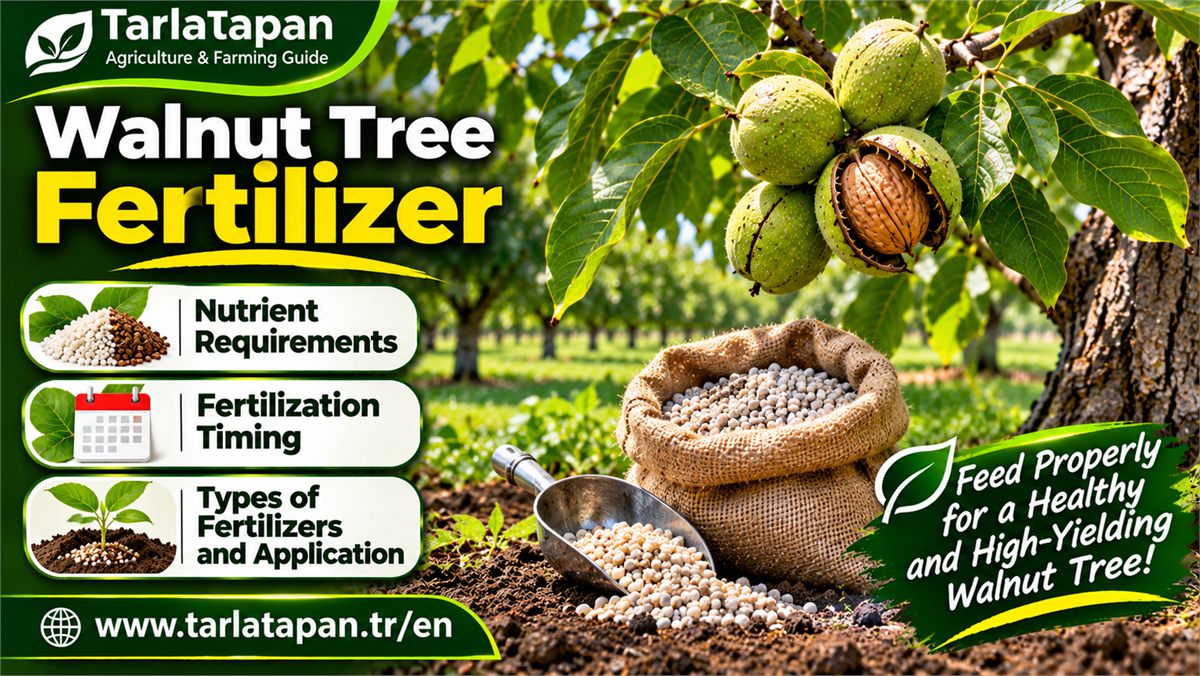
Fertilize walnut trees according to leaf and soil tests wherever possible. Without tests, use a schedule that increases with tree age: a 1-year-old tree needs roughly 100 g (3.5 oz) of actual nitrogen a year, rising to around 900 g (2 lb) at 10 years and 0.7–1.4 kg (1.5–3 lb) on large mature trees. Split nitrogen into several doses from spring to midsummer, give no nitrogen in the planting year, and spread fertilizer under the canopy, not against the trunk.
What Walnut Trees Need
Walnuts are large, fast-growing trees that produce oil-rich nuts, so they need nitrogen, phosphorus and potassium, plus micronutrients – especially zinc, boron and iron. Healthy leaf levels in midsummer samples:
| Nutrient | Adequate level in leaves (July / midsummer) |
|---|---|
| Nitrogen (N) | 2.2–3.2% |
| Phosphorus (P) | 0.1–0.3% |
| Potassium (K) | about 1.2% or more |
| Calcium (Ca) | about 1.0% or more |
| Magnesium (Mg) | about 0.3% or more |
| Zinc (Zn) | about 18 ppm or more |
| Manganese (Mn) | about 20 ppm or more |
| Copper (Cu) | about 4 ppm or more |
| Boron (B) | 36–200 ppm |
Fertilizer Schedule by Tree Age
Without tests, the following yearly amounts of pure nutrient per tree are a common starting point. The last column shows how far from the trunk to spread it.
| Tree age | Nitrogen (N) | Phosphorus (P) | Potassium (K) | Spread from trunk |
|---|---|---|---|---|
| 1 year | 100 g | 50 g | 50 g | 0.5 m (1.5 ft) |
| 2 years | 200 g | 100 g | 100 g | 1 m (3 ft) |
| 3 years | 300 g | 150 g | 150 g | 1.5 m (5 ft) |
| 4 years | 400 g | 200 g | 200 g | 2 m (6.5 ft) |
| 5 years | 500 g | 250 g | 250 g | 2.5 m (8 ft) |
| 6 years | 500 g | 300 g | 300 g | 2.5 m (8 ft) |
| 7 years | 600 g | 350 g | 350 g | 3 m (10 ft) |
| 8 years | 600 g | 400 g | 400 g | 3 m (10 ft) |
| 9 years | 700 g | 450 g | 450 g | 3 m (10 ft) |
| 10 years | 900 g | 500 g | 500 g | 3 m (10 ft) |
University of California guidelines for home trees give similar nitrogen rates by trunk size: about 0.15–0.25 kg (0.33–0.5 lb) actual N for 2–5-year-old trees, 0.35–0.7 kg (0.75–1.5 lb) at 8–10 years and 0.7–1.4 kg (1.5–3 lb) for mature trees.
Converting pure nitrogen to fertilizer: divide by the N percentage. For example, 500 g of N from ammonium sulfate (21% N) = 500 ÷ 0.21 ≈ 2.4 kg of fertilizer; from urea (46% N) ≈ 1.1 kg.
Nitrogen: Growth, Kernels and Timing
Nitrogen drives leaf and shoot growth and builds the leaf area needed to fill kernels. But timing matters:
- Nitrogen applied in late summer keeps shoots growing; they enter winter soft and are killed by early frost.
- Too much nitrogen increases walnut blight – soft, lush shoots are easily infected.
- Split the year's nitrogen into three or more doses from spring to midsummer, and water in after each.
- Give no nitrogen in the planting year; young trees benefit from light doses after their first growing season.
Potassium and Kernel Quality
Potassium is closely linked to kernel filling. It regulates water use, eases drought and frost stress and improves disease resistance. Potassium-deficient trees produce shrivelled, sometimes darker kernels. Uptake is harder in chalky soils and where phosphorus is excessive. Potassium sulfate or potassium nitrate are common sources.
Zinc Deficiency: Small, Narrow Leaves
Zinc shortage is the most common micronutrient problem in walnuts, especially on sandy, gravelly soils and on heavy or very alkaline soils.
- Leaves stay small, narrow and pointed.
- Leaves bunch into rosettes at shoot tips.
- Mature leaves turn pale between the veins.
- In severe cases shoots and small branches die back.
Foliar zinc sprays in spring are the usual fix; soil zinc works slowly.
When to Take Leaf Samples
Walnut leaf levels are judged in midsummer (July in the Northern Hemisphere). Take fully expanded leaflets from the middle of the current season's shoots, mix samples from trees across the orchard, and get them to the lab the same day. Test the soil before planting at several depths (0–30, 30–60, 60–90 and 90–120 cm / 0–4 ft).
Where and When to Apply
A walnut's feeding roots are concentrated under the canopy and toward its edge (the drip line), not at the trunk.
- Keep fertilizer at least 45 cm (18 in) from the trunk and spread it across the area under the branches.
- Phosphorus barely moves in soil – work it in before planting and in late winter.
- Potassium in late winter or early spring.
- Nitrogen in split doses from spring to midsummer.
- With drip irrigation, fertilizer can be applied through the water (fertigation).
- Well-rotted compost or manure improves soil, but fresh manure brings weed seeds and can burn roots.
Common Fertilizing Mistakes
- Applying the same fertilizer every year without testing.
- Piling fertilizer against the trunk.
- Putting nitrogen in the planting hole.
- Applying nitrogen in late summer.
- Over-applying phosphorus, which blocks uptake of iron, zinc, calcium, boron and manganese.
- Using fresh, unrotted manure.
- Mistaking zinc deficiency for iron deficiency.
Related Walnut Guides
- How to grow walnut trees: complete guide
- How often to water walnut trees
- Walnut tree yield and years to bear
- Why is my walnut tree dropping nuts?
Frequently Asked Questions
What is the best fertilizer for walnut trees?
The one your soil and leaf tests call for. Without tests, a nitrogen source (such as ammonium sulfate or urea) in split spring-to-summer doses, plus potassium and zinc where needed, suits most trees.
When should I fertilize my walnut tree?
Phosphorus and potassium in late winter or early spring; nitrogen split into several doses from spring to midsummer. Stop nitrogen by late summer.
How much fertilizer does a walnut tree need?
About 100 g (3.5 oz) of actual nitrogen per tree in year one, rising to 500 g at 5–6 years and about 900 g (2 lb) at 10 years, and up to 0.7–1.4 kg (1.5–3 lb) for large mature trees.
Should I fertilize a newly planted walnut tree?
No nitrogen in the planting year. Phosphorus and potassium can be worked into the soil before planting if a test shows a shortage.
Why are my walnut leaves small and yellow?
Small, narrow leaves in rosettes usually mean zinc deficiency; general yellowing can mean nitrogen shortage, iron deficiency in chalky or waterlogged soil, or root problems.
TarlaTapan guides focus on practical, field-tested growing advice. Corrections and suggestions are welcome at info@tarlatapan.tr.