Codling Moth and Walnut Husk Fly: When to Spray Walnuts
How to time sprays for codling moth and walnut husk fly with traps and degree-days, plus cultural and biological control.
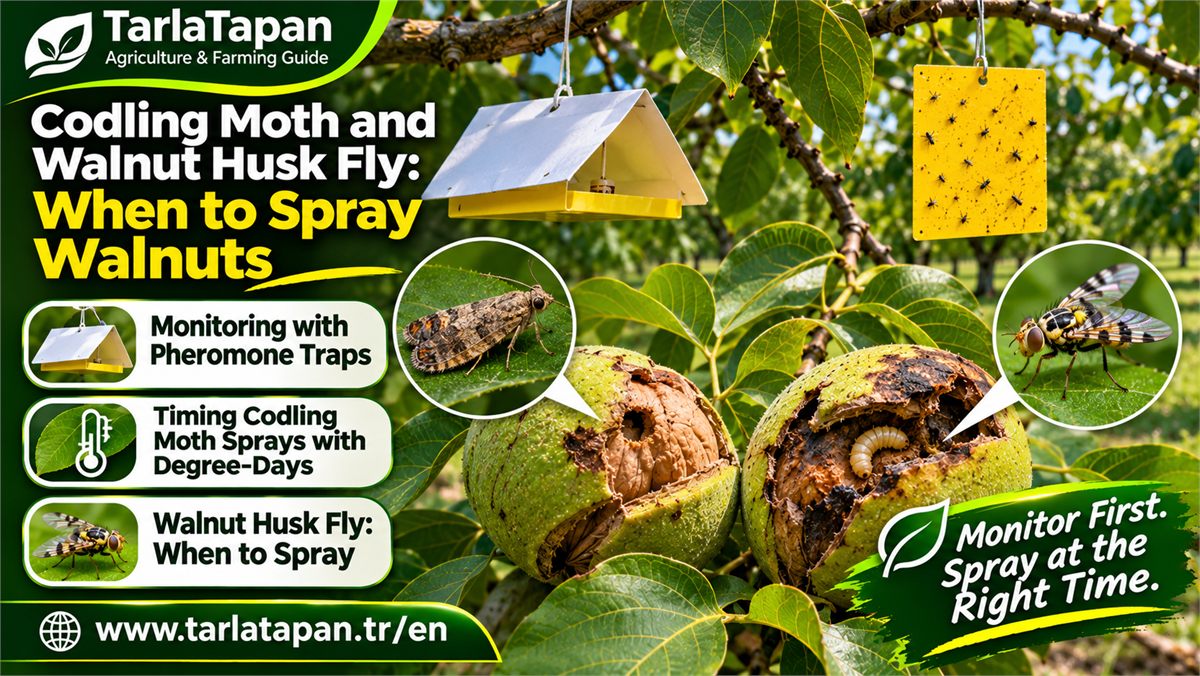
Spray walnut trees for insects by monitoring, not by the calendar. For codling moth, hang pheromone traps before moths emerge in spring; the first-generation larvae start hatching when about 150 degree-days (°C, base 10°C) have accumulated after the first moth is caught – usually when nuts are hazelnut-sized. Two sprays against the first generation, plus one against the second if needed, are enough in most orchards. For walnut husk fly, a mid- to late-summer pest in North America and parts of Europe, hang yellow sticky traps by early summer and spray when females are about to lay eggs. Your local pest-forecast service is the easiest way to get the exact spray dates.
Codling Moth vs Walnut Husk Fly
| Codling moth | Walnut husk fly | |
|---|---|---|
| What it is | Moth whose larva bores into the nut | Fly whose maggots feed in the husk |
| Generations | About 2 a year on walnut | 1 a year |
| Damage | Young nuts drop; wormy, mouldy kernels | Black, soft husks; stained shells; darker kernels |
| Main risk period | Late spring – early summer (1st generation) | Mid to late summer, until husk split |
| Monitoring | Pheromone traps | Yellow sticky traps with ammonium bait |
Codling Moth Damage on Walnuts
The codling moth is the same pest that attacks apples, pears and quinces. On walnut it has about two generations a year:
- First generation: larvae enter through the green husk and bore through the still-soft shell into the kernel. These nuts drop. This generation causes most of the economic loss.
- Second generation: larvae mostly feed in the husk because the shell has hardened, but they can enter varieties with poorly sealed shells through the stem end.
In untreated orchards losses reach about 18–22%.
How to recognise wormy walnuts
- A small entry hole in the husk with darkening and frass (larval droppings) around it.
- Entry points where nuts touch each other or a leaf, or near the stem.
- Small nuts dropping in early summer – cut them open to find tunnels, frass and a pinkish-white larva up to 15–20 mm long.
Codling Moth Life Cycle
Mature larvae overwinter in cocoons under loose bark, in debris, in nuts and in stores. They pupate in spring, and first-generation moths emerge from mid-spring into early summer. Moths mate and lay eggs a day or so after emerging, but only when dusk temperatures stay above about 15°C (59°F) for two evenings in a row.
Monitoring with Pheromone Traps
- When: 7–10 days before the first moths are expected – usually mid-spring.
- How many: about one trap per 100 trees, at least two per orchard.
- Where: outer canopy on the south to south-east side, 1.5–2 m (5–6.5 ft) high.
- Checking: 2–3 times a week until the first moth is caught ("biofix"), then weekly. Replace lures as directed.
Timing Codling Moth Sprays with Degree-Days
Codling moth develops above 10°C (50°F). Daily degree-days = (minimum + maximum temperature) ÷ 2 − 10, added up day by day.
| Degree-days (°C) | What happens |
|---|---|
| About 150 after the first moth catch (biofix) | First-generation larvae start to hatch – first spray window |
| About 90 after egg laying | Eggs hatch |
| About 800 from 1 January | Second-generation hatch expected |
In Fahrenheit terms (base 50°F) the first-generation hatch is commonly placed around 250–300 degree-days after biofix. Sprays must reach the larvae before they enter the nut – once inside, insecticides cannot reach them.
Walnut Husk Fly: When to Spray
Walnut husk fly has one generation a year. Pupae overwinter in the soil and adults emerge from early summer to late summer, peaking in mid-summer. Females lay eggs under the husk surface in groups of about 15; maggots hatch within about 5 days and feed for 3–5 weeks, turning the husk soft and black.
- Early infestations (mid-summer) cause shrivelled, dark, mouldy kernels and can cut nut value by about 30%. Late infestations mostly stain shells and make hulling difficult.
- Hang unbaited yellow sticky traps charged with ammonium carbonate by early summer, high in dense foliage on the north side of the tree – at least two traps per 4 ha (10 acres).
- Spray when trap catches rise and females are about to lay eggs; bait sprays combining a small amount of insecticide with a protein bait are widely used, including organic options.
- Husk flies are no longer a problem after husk split.
- Some varieties (for example Franquette, Hartley and Serr) and black walnut are particularly susceptible.
Cultural Control: Fewer Pests Every Year
- Collect and destroy fallen wormy nuts every week before larvae leave them.
- In early summer, wrap two layers of corrugated cardboard (2.5–3 cm / about 1 in wide) around the trunk about 50 cm (20 in) above the ground; codling moth larvae pupate there – check and destroy weekly.
- Do not plant apples, pears or quinces in or next to the walnut orchard; they are alternative hosts.
- Keep nut stores away from the orchard and clean them, since larvae can overwinter there.
- For husk fly, harvesting promptly reduces late damage.
Biological and Low-Impact Methods
- Birds, especially woodpeckers, can remove most larvae sheltering in trunk bands; tiny Trichogramma wasps parasitise codling moth eggs.
- Avoid unnecessary broad-spectrum sprays that kill these natural enemies; choose selective products.
- Keep hedgerows and flowering plants around the orchard to shelter beneficial insects.
- Mating disruption – dispensers that flood the orchard with pheromone – prevents moths from finding mates in larger orchards.
Common Mistakes
- Spraying on a fixed calendar date instead of following traps and degree-days.
- Spraying after larvae have already entered the nuts.
- Never hanging traps, or never changing the lures.
- Leaving wormy nuts under the trees.
- Forgetting nearby apple, pear and quince trees.
- Spraying broad-spectrum insecticides every week and wiping out beneficial insects.
- Ignoring the pre-harvest interval on the product label.
Related Walnut Guides
- How to grow walnut trees: complete guide
- Walnut tree diseases
- Why is my walnut tree dropping nuts?
- When to harvest walnuts
Frequently Asked Questions
When should I spray my walnut tree for worms?
Against codling moth, spray when first-generation larvae start hatching – about 150 °C degree-days after the first moth is caught in a pheromone trap, usually when nuts are hazelnut-sized.
How many times should walnuts be sprayed for codling moth?
Usually two sprays against the first generation and, if traps show it is needed, one against the second.
When do you spray for walnut husk fly?
In mid to late summer, when yellow sticky traps show rising catches and females are about to lay eggs. Sprays are not needed after husk split.
What causes black husks on walnuts?
Walnut husk fly maggots feeding inside the husk are a common cause; walnut blight and sunburn can also blacken husks.
Are wormy walnuts safe to eat?
Nuts with larvae, frass or mould inside should be discarded. Husk-fly-stained shells with a clean, light kernel inside are safe.
TarlaTapan guides focus on practical, field-tested growing advice. Corrections and suggestions are welcome at info@tarlatapan.tr.