Best Walnut Tree Varieties (Including Late-Frost Areas)
How to choose a walnut variety: late leafing for frost, lateral bearing, disease tolerance and pollinators, with popular varieties compared.
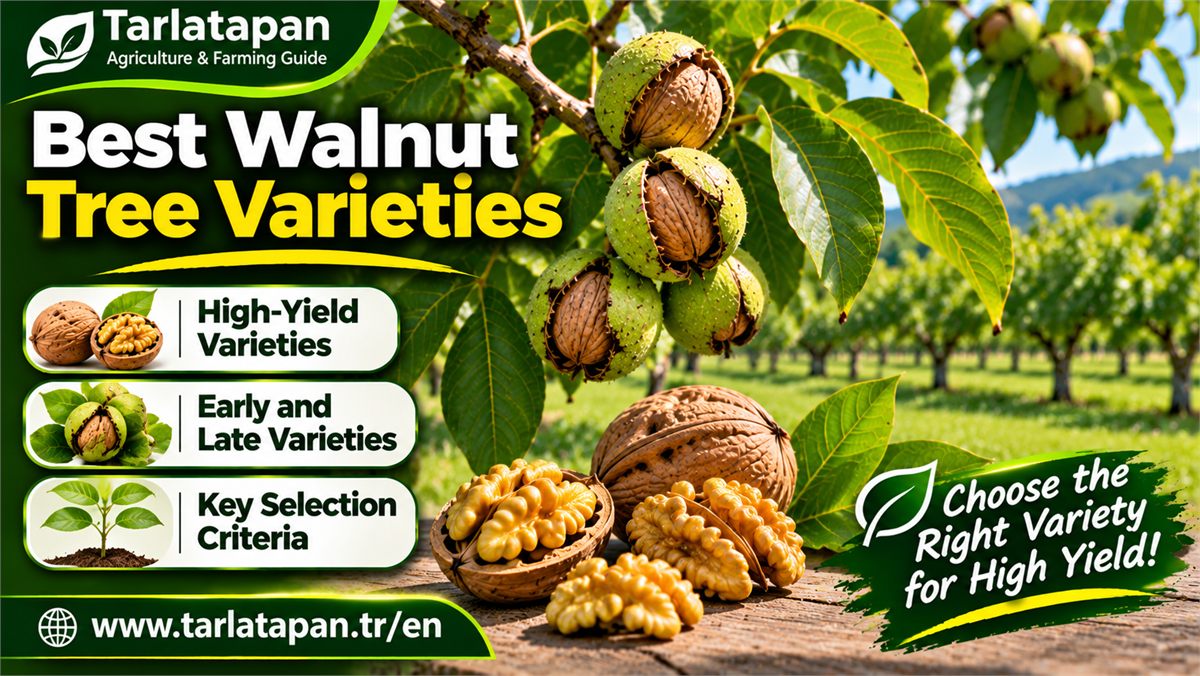
The first thing to check when choosing a walnut variety is late spring frost. In frost-prone areas, late-leafing varieties such as Franquette, Fernor, Lara, Ronde de Montignac and Meylannaise leaf out and flower after most frosts have passed, while early-leafing varieties lose their crop in many years. After that, compare kernel ratio, lateral bearing, disease tolerance and pollinator match. Variety and site are decided once – changing them after planting costs years.
What Makes a Good Walnut Variety
- Leafs out late enough to avoid spring frost in your area.
- Tolerates anthracnose, walnut blight and sunburn.
- Nut weight around 12 g or more, kernel 6 g or more.
- Kernel ratio above 50%, with kernels that come out whole.
- Light-coloured, well-filled kernels and a well-sealed shell.
- Lateral bearing – fruit on side shoots, not just branch tips – for earlier and heavier crops.
- A pollinator whose pollen release matches its female bloom.
Popular English Walnut Varieties Compared
| Variety | Leafing | Bearing | Notes |
|---|---|---|---|
| Chandler | Late | Lateral | Leading commercial variety; light kernels; vigorous. Pollinated by Franquette. |
| Fernor | Very late | Lateral | French; good for late-frost sites. Pollinated by Fernette, Meylannaise or Ronde de Montignac. |
| Franquette | Very late | Terminal | Old French variety; thick husk gives good tolerance to blight, anthracnose and sunburn; widely used as a pollinator. |
| Lara | Late | Lateral | Large nuts, good disease tolerance, productive. |
| Howard | Mid | Lateral | Compact, productive Californian variety. |
| Tulare | Mid | Lateral | Vigorous, light kernels; susceptible to husk fly. |
| Hartley | Mid | Terminal | Classic in-shell variety with an attractive shell. |
| Pedro | Mid | Lateral | Small, early-bearing tree; sensitive to anthracnose and sunburn. |
| Serr | Early | Lateral | High kernel ratio but prone to flower drop from excess pollen and to frost. |
Measured kernel ratios in one trial: Chandler about 54%, Fernor about 49%, Franquette about 42%. Ratios vary with climate and management; use them for comparison, not as guarantees.
Varieties for Cold Climates and Gardens
- Carpathian walnuts: strains of English walnut selected in Eastern Europe for winter hardiness, often grown in USDA zones 5–6 where standard varieties struggle.
- Broadview and Buccaneer: widely grown in the UK; relatively compact and early to bear, suited to gardens.
- Franquette and Fernor: late leafing makes them reliable where spring frosts are common.
- Black walnut (Juglans nigra) and butternut (J. cinerea): very hardy, but grown more for timber and wild-flavoured nuts; shells are very hard. Black walnut also releases more juglone, which harms many garden plants.
Why Late Leafing Beats Frost
The most effective way to escape spring frost is for the tree to wake up after the last frost. Leafing dates between varieties can differ by several weeks, so in the same orchard an early variety may be frozen while a late one flowers safely. Flower type matters too: varieties where catkins shed pollen first (protandrous) need a pollinator that releases pollen later.
Disease Tolerance
- Franquette: thick husk, more tolerant of anthracnose, codling moth, blight and sunburn than most.
- Lara: good overall disease tolerance.
- Pedro: sensitive to anthracnose and sunburn.
- Chandler and Fernor: late flowering, but young shoots can be damaged by very hard winters; avoid late-summer nitrogen so shoots harden off.
- Tulare, Hartley, Serr, Franquette: listed as very susceptible to walnut husk fly where that pest occurs.
Site Matters as Much as Variety
Cold air is heavy; on clear, still nights it flows downhill and pools in hollows and valley floors. An orchard on a slope can escape a frost that destroys one on the flat below.
- Choose ground slightly higher than its surroundings with good air drainage.
- Do not block the low end of the orchard with walls or dense hedges – trapped cold air stays in the orchard.
- Avoid valley floors and closed hollows.
Recognising Frost Damage
- New leaves and shoot tips look water-soaked, then blacken within a day or two.
- The feathery stigmas of female flowers turn brown and do not set nuts.
- Catkins blacken and release no pollen.
- Frozen small nuts are brown inside and drop within weeks.
Walnuts regrow from secondary buds after frost. Do not prune frozen shoots immediately – wait a few weeks to see which buds survive – and keep watering during regrowth.
Changing a Wrong Variety Costs Years
A wrongly chosen variety can only be fixed by replanting or by top-working (grafting the tree over to a new variety); both cost at least 3–5 years. A wrong site can never be fixed. Before planting, check local last-frost dates and ask which varieties old orchards nearby have done well with.
Related Walnut Guides
- How to grow walnut trees: complete guide
- When to plant walnut trees
- Where do walnuts grow?
- Walnut tree yield and years to bear
Frequently Asked Questions
What is the best walnut tree variety?
There is no single best. Chandler is the leading commercial variety where frost is not a problem; Fernor, Franquette and Lara suit late-frost areas; Carpathian strains suit cold winters; Broadview and Buccaneer suit UK gardens.
Which walnut variety bears the earliest?
Lateral-bearing varieties such as Chandler, Howard, Pedro and Lara bear earlier than terminal-bearing types like Franquette and Hartley.
What is the best walnut tree for a small garden?
A compact, early-bearing variety such as Broadview, Buccaneer or Pedro – but every walnut eventually becomes a large tree, so allow plenty of space.
What is a good pollinator for Chandler walnuts?
Franquette is the classic pollinator for Chandler; it is also used for Fernor, Fernette and Pedro.
Which walnut is most frost-resistant?
For spring frost, late-leafing varieties such as Fernor and Franquette. For hard winter cold, Carpathian strains of English walnut, or black walnut.
TarlaTapan guides focus on practical, field-tested growing advice. Corrections and suggestions are welcome at info@tarlatapan.tr.