When to Harvest Walnuts and How to Remove the Husk
How to tell when walnuts are ripe, harvesting methods, why hulls must come off the same day, and how to wash and sort nuts.
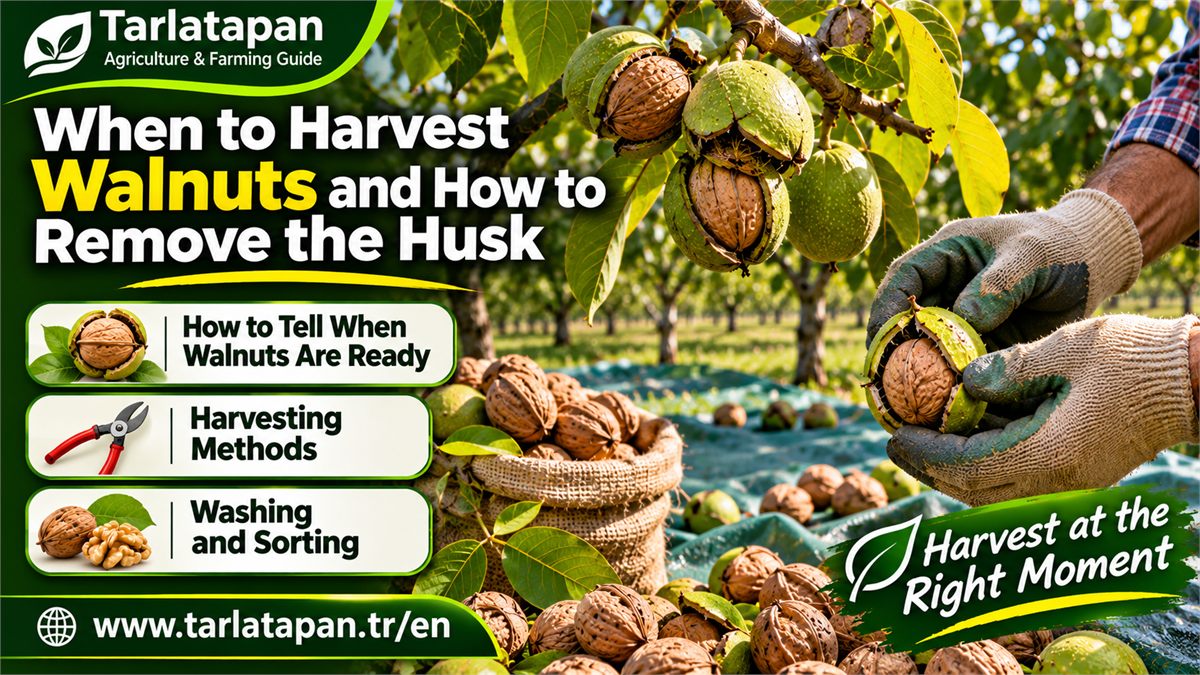
Walnuts are harvested in early to mid autumn (September–October in the Northern Hemisphere, March–April in the Southern), depending on variety and altitude. Let the nut, not the calendar, decide: crack one open, and if the thin packing tissue between the kernel halves has turned brown, the nut is mature. At that point the green husk starts to split and comes away from the shell easily. Harvest as early as you can once nuts are ready, remove the husks on the same day, wash and dry them – nuts left in their husks quickly develop dark, low-value kernels.
How to Tell When Walnuts Are Ready
The kernel matures before the green husk does, so judge ripeness from the inside:
- Packing tissue: the papery membrane dividing the kernel halves has turned fully brown.
- Husk: it has started to split and separates from the shell without much effort.
- Branch: nuts drop with a light shake.
- Sampling: crack 10–20 nuts from different trees and heights before deciding.
A practical rule in orchards is to start when about 85% of nuts come off with a shake and around 95% of husks separate cleanly. Some growers start when roughly one-third of husks on the tree have split.
The Cost of Harvesting Too Early or Too Late
- Too early: if a quarter or more of the nuts you collect will not come out of their husks, wait a few days.
- Too late: nuts left on the tree or ground darken, are attacked by codling moth and mould, and nuts lying in wet grass stain. Harvesting promptly also limits rain damage.
Before harvest, mow or clear the ground under the trees so fallen nuts can be found and picked up quickly.
Harvesting Methods
- Hand picking: collect nuts within reach and pick up those that fall. Suits gardens and young trees.
- Shaking: shake the trunk or main branches so nuts drop onto a tarp or net spread underneath. Saves time on large trees.
- Mechanical harvest: commercial orchards use trunk shakers to drop the nuts and sweepers or pick-up machines to collect them. This needs an orchard designed for machines from the start.
Shaking Without Damaging the Tree
Beating branches with long poles is the traditional method, but it breaks shoot tips and buds, wounds next year's fruiting wood and opens the way for walnut blight. To limit damage:
- Use wooden or plastic poles, never metal.
- Avoid hitting shoot tips and young branches; shake the branch instead where possible.
- If you shake the trunk with a rope, use one with a rubber sleeve so it does not strip the bark.
- When climbing, stand only on thick limbs.
Why Hulls Must Come Off the Same Day
A picked husk is still living tissue. Its dyes and moisture pass into the shell and then to the kernel. Nuts left in their husks:
- heat up, turn black and stain the shell;
- develop dark kernels from trapped heat and moisture;
- start to mould and rot;
- dry later and store for less time.
Light-coloured kernels fetch the best prices. The same tree's nuts can come out light if hulled and dried the same day, or dark if they sit in a pile for three days.
Hulling by Hand and by Machine
For small harvests, remove husks by hand. The husk contains a strong dye that stains skin dark brown, so wear gloves. Stains fade after a few weeks; rubbing with lemon helps. Stubborn husks can be cut away with a knife, or nuts can be spread on a damp tarp for one day to soften the husks – longer than that darkens the kernels.
Commercial growers use hullers that strip husks with rotating brushes and water sprays.
Washing and Sorting
After hulling, rinse the nuts in clean water to remove husk residue, soil and surface tannins that stain the shell. Nuts that float are usually empty, shrivelled or wormy – remove them. Then move straight on to drying (see our guide on how to dry and store walnuts).
Related Walnut Guides
- How to grow walnut trees: complete guide
- How to dry and store walnuts
- Codling moth and husk fly: when to spray
- Walnut tree yield and years to bear
Frequently Asked Questions
What month are walnuts ready to harvest?
In the Northern Hemisphere usually September to October; in the Southern Hemisphere roughly March to April. Exact timing depends on variety, altitude and the season.
How do you know when walnuts are ripe?
Crack a nut: the membrane between the kernel halves should be brown, and the green husk should be splitting and easy to remove.
Can you eat walnuts straight from the tree?
Yes, once mature and out of the husk. Fresh "wet" walnuts are soft and mild; for storage they must be dried.
Why are my walnut kernels dark?
Late harvest, husks left on too long, nuts lying on damp ground, drought or sunburn during kernel fill, and drying at too high a temperature all darken kernels.
How do you remove the green husk from walnuts?
Peel it off by hand with gloves when it has started to split. Stubborn husks can be cut off, or softened for a single day on a damp tarp.
TarlaTapan guides focus on practical, field-tested growing advice. Corrections and suggestions are welcome at info@tarlatapan.tr.