How Long Until a Walnut Tree Produces Nuts? Yield per Tree
How many years until walnuts bear, yield per tree by age, yield per hectare and acre, and kernel ratio explained.
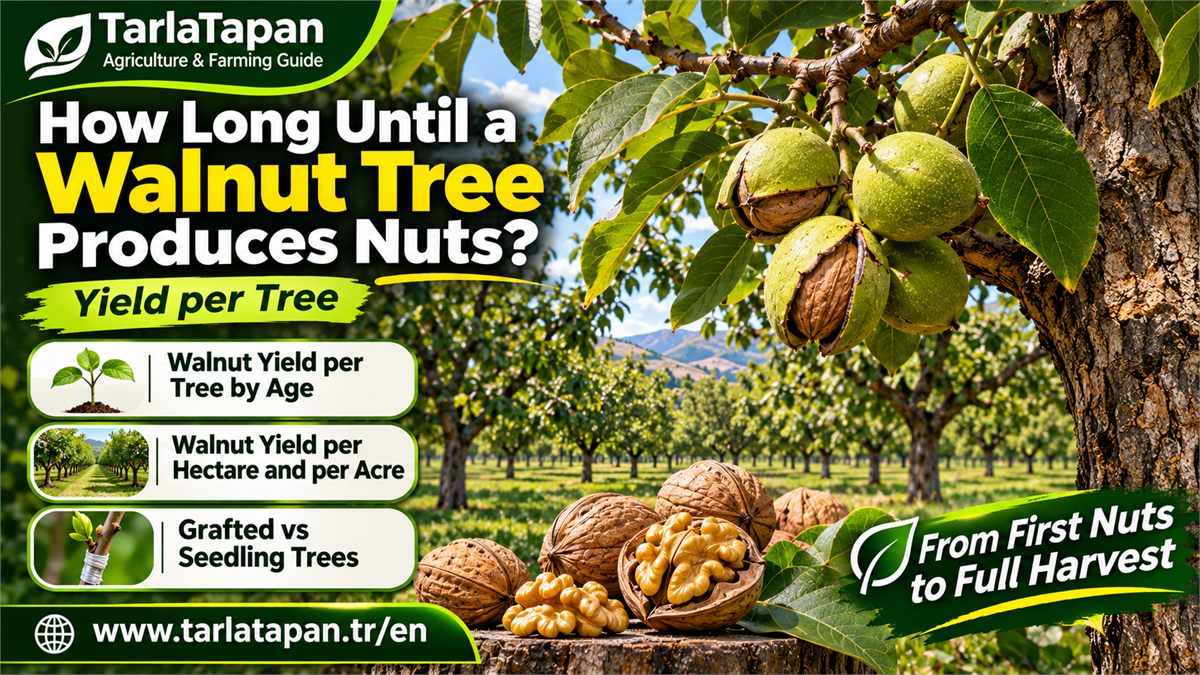
A grafted walnut tree usually produces its first nuts about 3 years after planting, crops regularly from 3–5 years and reaches full yield at 8–10 years. A tree grown from seed typically takes 12–15 years to bear well. At full production, a tree in a commercial orchard (7 × 7 m / 23 × 23 ft spacing) gives about 40–60 kg (90–130 lb) of dried in-shell nuts a year, and an old, free-standing tree can give 100–150 kg (220–330 lb). Roughly half the weight of an in-shell walnut is kernel.
How Long Until a Walnut Tree Produces Nuts?
- Grafted tree: first nuts about 3 years after planting; regular crops from year 3–5.
- Full yield: 8–10 years after planting in a commercial orchard.
- Seedling (grown from a nut): often 12–15 years before reliable crops; some bear a few nuts at 7–10 years, but yields are low and irregular.
- Lateral-bearing varieties (such as Chandler), which fruit on side shoots, start earlier than older terminal-bearing types that fruit only at branch tips.
- Black walnut (Juglans nigra) is slower still, commonly 10 years or more from seed.
When planning an orchard, do not count on income in the first 4–5 years; the small early crops cover only part of the running costs.
Walnut Yield per Tree by Age
Yield rises steadily with age. Published estimates for a well-managed, grafted, irrigated tree with plenty of space:
| Tree age | Approx. in-shell yield per tree |
|---|---|
| 5 years | 4 kg (9 lb) |
| 8 years | 20 kg (44 lb) |
| 12 years | 40 kg (88 lb) |
| 14 years | 75 kg (165 lb) |
| 20 years | up to 120 kg (265 lb) |
Trees in dense orchards yield less each (40–60 kg) but more per hectare. Trees that are not watered, pruned or protected from disease yield far less.
Walnut Yield per Hectare and per Acre
Yield per area = number of trees × yield per tree.
| Spacing | Trees/ha | Assumed yield per tree | In-shell yield per hectare | Per acre |
|---|---|---|---|---|
| 10 × 10 m | 100 | 100 kg | about 10 t | about 4 t (8,900 lb) |
| 8 × 8 m | about 156 | 60 kg | about 9–9.5 t | about 3.7 t |
| 7 × 7 m | about 204 | 40–60 kg | about 8–12 t | about 3.3–4.9 t |
These are full-production figures for a well-managed orchard. Real results are usually lower and vary widely: good 12-year-old orchards commonly reach around 5 t/ha, while the best mature grafted orchards can exceed 10 t/ha.
Grafted vs Seedling Trees: The Yield Gap
- Grafted orchards can produce around 50–60% more nuts than seedling trees of the same age.
- Grafted trees bear at 3–5 years; seedlings at 12–15.
- Grafted nuts are true to the variety – large, thin-shelled, with a high kernel ratio.
- From 6 kg of seedling nuts you may get only about 2 kg of kernel; the same weight from a good grafted variety gives 3 kg or more.
- Seedling trees often crop heavily one year and lightly the next (alternate bearing).
Kernel Ratio: In-Shell vs Shelled Walnuts
Always check whether a yield figure means in-shell or shelled nuts. The figures above are dried in-shell weight; kernel weight is roughly half.
Kernel ratio (%) = kernel weight ÷ in-shell weight × 100. Commercial varieties should be above 50%.
| Variety | In-shell nut (g) | Kernel (g) | Kernel ratio |
|---|---|---|---|
| Chandler | 10.4 | 5.5 | 54% |
| Fernor | 14.2 | 6.2 | 49% |
| Franquette | 13.2 | 5.6 | 42% |
Example: an orchard producing 8 t/ha in-shell at a 54% kernel ratio yields about 4.3 t/ha of kernels.
What Affects Kernel Ratio
- Variety – the biggest factor; varieties range from under 40% to over 55%.
- Water during kernel fill in mid to late summer – drought leaves the shell the same size but shrinks the kernel.
- Summer temperature – cool summers can leave kernels underfilled.
- Sunburn – shrivels and darkens kernels.
- Nutrition – potassium and zinc shortages impair filling.
- Drying – nuts that are not fully dry weigh more in-shell and give a falsely low ratio.
What Lowers Walnut Yield
- Seedling or wrongly named trees.
- No pollinator variety – heavy flowering but poor nut set.
- Late spring frost, which can wipe out a year's crop in one night.
- Too little water, especially during kernel fill.
- Anthracnose and walnut blight – leaf loss and nut drop.
- Codling moth – 18–22% loss in untreated orchards.
- Dense crowns that leave inner branches in shade.
- Heavy soils with a high water table, where trees decline after a few good years.
How to Increase Walnut Yield
- Choose a lateral-bearing variety with a high kernel ratio that suits your climate, plus a compatible pollinator.
- Install drip irrigation and never let trees go dry during kernel fill.
- Fertilize according to leaf and soil tests; stop nitrogen by late summer.
- Build a strong crown in the first three years, then prune lightly to keep light in the tree.
- Clear fallen leaves against anthracnose and monitor codling moth with traps.
- Harvest on time, hull the same day and dry correctly to protect saleable yield.
Related Walnut Guides
- How to grow walnut trees: complete guide
- Best walnut tree varieties
- Is a walnut orchard profitable?
- Why is my walnut tree dropping nuts?
- How often to water walnut trees
Frequently Asked Questions
How many years does it take a walnut tree to bear nuts?
A grafted walnut bears its first nuts about 3 years after planting and reaches full yield in 8–10 years. A seedling tree often takes 12–15 years.
How many walnuts does one tree produce?
A mature tree in a commercial orchard gives about 40–60 kg (90–130 lb) of in-shell nuts a year; an old, free-standing tree can give 100–150 kg (220–330 lb).
What is the yield of walnuts per acre?
It varies widely with age, spacing, variety and care – from about 2 short tons per acre (around 5 t/ha) in a good young orchard to over 4 short tons per acre (10 t/ha) in the best mature orchards.
What is a good kernel ratio for walnuts?
Above 50%. Good commercial varieties reach 53–57%; seedling nuts are often only 30–40%.
Do walnut trees produce every year?
Grafted, well-managed trees crop every year. Seedling trees and stressed trees often alternate heavy and light years.
TarlaTapan guides focus on practical, field-tested growing advice. Corrections and suggestions are welcome at info@tarlatapan.tr.