Walnut Tree Diseases: Anthracnose, Blight and Root Rot
How to identify and control walnut anthracnose, walnut blight, root and crown rots, thousand cankers disease and common pests.
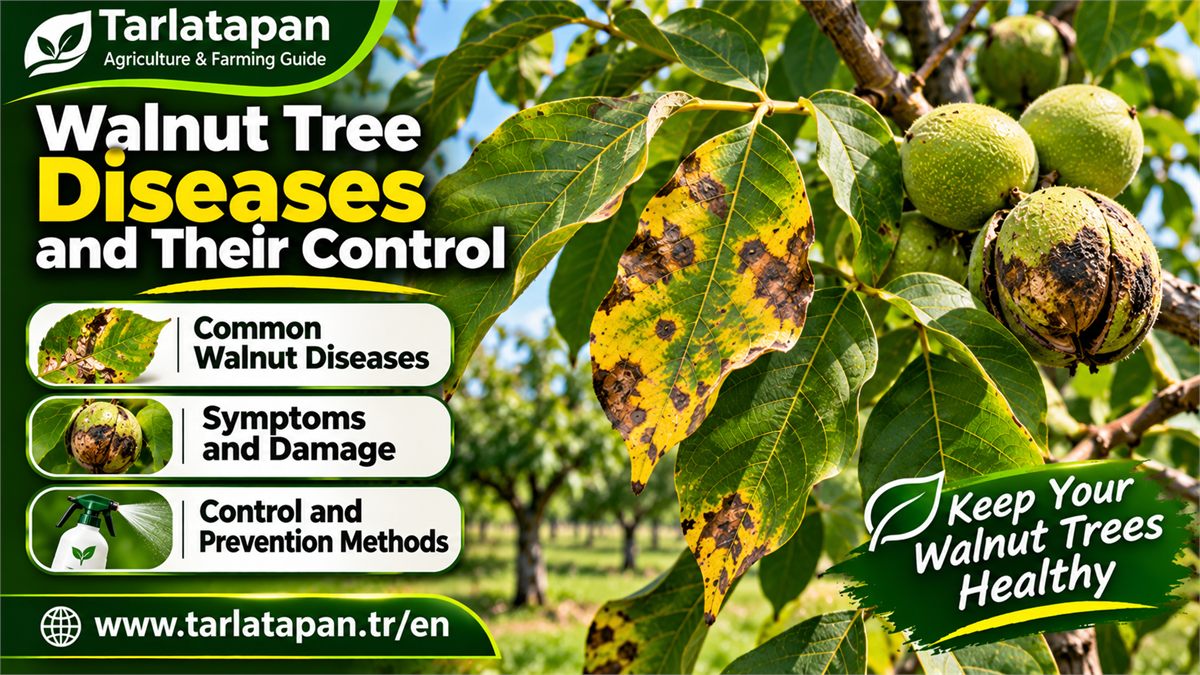
The two walnut diseases that cause the most crop loss are walnut anthracnose (a fungus) and walnut blight (a bacterium). In anthracnose, leaves show round brown spots with darker edges, often with a yellow halo and tiny dark dots arranged in rings. In walnut blight, spots are angular, black and bounded by leaf veins, flowers turn black, and nuts develop sunken black lesions. Because the two are controlled differently, correct identification comes first. Root and trunk problems – Phytophthora root rot, crown gall, Armillaria root rot and, in parts of the United States, thousand cankers disease – are less common but can kill trees.
The Main Walnut Diseases at a Glance
| Disease | Cause | Key sign |
|---|---|---|
| Anthracnose | Fungus (Ophiognomonia leptostyla) | Round brown leaf spots, early leaf drop |
| Walnut blight | Bacterium (Xanthomonas) | Black angular spots, black flowers, sunken black spots on nuts |
| Phytophthora root and crown rot | Water mould | Wilting, dark bark at the soil line, decline in wet soils |
| Crown gall | Bacterium (Agrobacterium) | Rough galls on roots and lower trunk |
| Armillaria root rot | Fungus | Small yellow leaves, dieback, honey-coloured mushrooms at the base |
| Blackline | Virus (cherry leaf roll virus) | Decline and a dark line at the graft union |
| Thousand cankers disease | Fungus spread by a twig beetle | Yellowing, wilting and dieback, many small cankers under the bark |
Walnut Anthracnose
Anthracnose is a fungal disease that overwinters on fallen infected leaves and infects new leaves in spring rain. It spreads by wind and splashing water, and humid weather makes it worse.
- Leaves are infected once leaflets are about half grown; symptoms appear 12–14 days later.
- Spots start as small, greyish, dark-edged lesions about 2–5 mm across, then turn light to dark brown with a yellow halo.
- Spots merge into large dead patches; severely affected trees drop leaves early in summer.
- On the husk, brown spots with a dirty white coating appear; kernels of badly affected nuts stay shrivelled and dark.
Walnut Blight (Bacterial Blight)
Walnut blight overwinters in infected buds, leaf scars and twig cankers. In spring it moves to the flowers and spreads with rain to leaves, shoots and nuts, entering through pores and wounds. Symptoms show 10–15 days after infection, and it develops fastest at 28–32°C (82–90°F). Losses can exceed 50% in badly infected orchards.
- Male and female flowers turn completely black and dry up.
- Leaves get small, angular, brown-black spots bounded by veins; leaves become distorted.
- Nuts show oily-green spots that turn black and sunken; infected young nuts drop and the kernel rots.
- Shoot tips die back and cankers form on twigs.
How to Tell Anthracnose from Walnut Blight
| Symptom | Anthracnose (fungus) | Walnut blight (bacterium) |
|---|---|---|
| Leaf spot shape | Round, dark edge, brown centre, yellow halo | Angular, bounded by veins, brown-black |
| On the spot | Tiny dark dots in rings | No dots |
| Flowers | Usually not affected | Turn black and dry up |
| Shoots | Spots on young shoots | Tip dieback and cankers |
| Nuts | Brown spots with a whitish coating | Oily-green spots turning black and sunken; kernel blackens |
Root, Crown and Trunk Diseases
- Phytophthora root and crown rot: thrives in waterlogged soil. Trees wilt and decline; bark at the soil line is dark and wet. Prevent it with good drainage, by keeping irrigation water away from the trunk and by planting the graft union above soil level.
- Crown gall: galls on roots and lower trunk; weakens young trees. Plant only clean nursery stock and avoid wounding roots and trunks.
- Armillaria root rot (oak root fungus): survives on old roots in the soil and cannot be cured once established. Remove dead trees with their roots; resistant rootstocks are the best prevention.
- Blackline: a virus that moves in pollen and infected graft wood; affected English walnuts on certain rootstocks decline. Use virus-free budwood.
- Thousand cankers disease: mainly a problem of black walnut in parts of the United States; the walnut twig beetle carries a fungus that creates countless small cankers. Do not move walnut firewood or logs out of affected areas.
Common Walnut Pests
- Codling moth: larvae bore into young nuts and cause drop; up to 18–22% loss in untreated orchards.
- Walnut husk fly: maggots feed in the husk, turning it black and staining the shell (mainly in North America and parts of Europe).
- Aphids: suck sap under leaves and leave sticky honeydew; heavy infestations yellow the leaves and keep nuts small.
- Leaf blister mite: raised blisters on leaves; heavy attacks can distort nuts.
- Scale insects: crusts on branches that weaken the tree.
What Increases Disease Risk
- Dense, unpruned crowns that stay wet.
- Flood or overhead irrigation that wets leaves and trunks.
- Low, still sites where humidity lingers.
- Too much nitrogen – soft, lush shoots are easily infected by blight.
- Late frost and hail, which leave wounds for bacteria.
Prevention and Control
- Rake up and destroy fallen leaves in autumn – they are the main source of anthracnose.
- Cut out diseased shoots and branches and remove infected nuts that drop early.
- Disinfect pruning tools between trees (a 10% household bleach solution works) and seal large cuts.
- Plant certified, disease-free trees; never take graft wood from infected trees.
- Use drip irrigation and keep water off leaves and the trunk.
- Prune to keep the crown open and airy.
- Where sprays are needed, copper-based products are commonly used against blight and fungicides against anthracnose, timed from bud break through flowering and after rain. Follow your local extension service's spray calendar and product label.
Related Walnut Guides
- How to grow walnut trees: complete guide
- Codling moth and husk fly: when to spray
- Why is my walnut tree dropping nuts?
- How to prune a walnut tree
- How often to water walnut trees
Frequently Asked Questions
What causes black spots on walnut leaves?
Angular black spots bounded by veins usually mean walnut blight; round brown spots with a yellow halo usually mean anthracnose.
Why are my walnut tree leaves turning yellow and falling?
Early leaf drop is commonly caused by anthracnose. Yellowing combined with wilting can also point to root rot, drought or, near black walnuts, juglone sensitivity in other plants.
Can walnut blight be cured?
It cannot be removed from an infected tree, but it can be kept down with sanitation, good pruning, avoiding wet foliage and copper sprays at the right time.
When should I spray my walnut tree?
Disease sprays are usually timed from bud break through flowering and after spring rain; insect sprays depend on monitoring. Follow your local spray calendar.
What is killing my walnut tree?
Sudden decline of a whole tree is often caused by root and crown problems – Phytophthora in wet soil, Armillaria root rot, or in parts of the United States thousand cankers disease.
TarlaTapan guides focus on practical, field-tested growing advice. Corrections and suggestions are welcome at info@tarlatapan.tr.