Is a Walnut Orchard Profitable?
Walnut orchard costs and revenue: establishment, waiting years, running costs, in-shell vs shelled sales and payback.
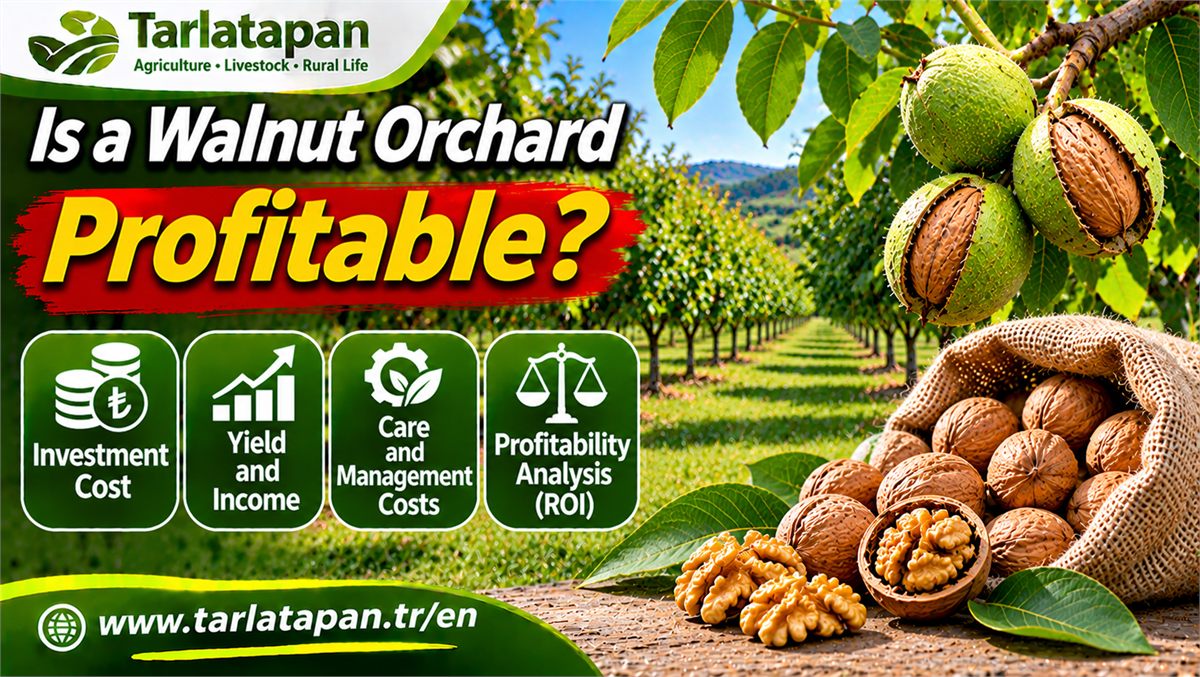
A walnut orchard can be profitable in the long run if it is planted on the right site, with the right variety and with irrigation – but the first years are all cost. Trees give their first nuts at 3–5 years and reach full yield at 8–10. In published budgets for well-managed orchards, yearly cash flow typically turns positive around year five, and the full investment is often recovered only after about 10 years. Walnut is a 40–50-year investment, and it should be planned that way.
Establishment Costs
The first year is the most expensive. Typical cost items:
- Land: purchase or rent – or, if you own it, the rent you give up.
- Soil and water tests.
- Land preparation: deep ripping, cultivation, levelling and drainage if needed.
- Trees: certified, grafted trees, including pollinators.
- Planting: holes, planting labour and initial watering.
- Irrigation system: usually drip or micro-sprinklers.
- Stakes, ties and tree guards, fencing where needed.
Trees and Irrigation: The Two Biggest Items
- Number of trees depends on spacing: about 100 per hectare (40 per acre) at 10 × 10 m, 156 at 8 × 8 m, 204 at 7 × 7 m and 300–400 in high-density plantings. Denser planting costs more up front but gives more nuts per hectare in the early years.
- Buy certified, named trees. Cheap, unnamed or seedling trees are the costliest mistake in walnut growing – you find out years later.
- Irrigation is not optional in most climates; it decides kernel quality and yield.
The Waiting Years
For the first 3–4 years there is little or no crop, but costs continue: water and energy, fertilizer, sprays, training and pruning, weed control, and replacing trees that die. Do not count on income in the first 4–5 years.
Annual Running Costs at Full Production
- Fertilizer – rises as trees grow.
- Irrigation energy – water use per tree increases sharply with age.
- Pest and disease control – anthracnose, walnut blight, codling moth, monitoring traps.
- Pruning labour.
- Orchard floor management – mowing or cover crops.
- Harvest and processing (below).
- Land rent, insurance, machinery and overheads.
Harvest and Processing Costs
Harvest is only the first step to a saleable product:
- picking or shaking – labour or machine hire;
- hulling – by hand or with a huller;
- washing and drying – racks or a dryer, plus energy;
- sorting and grading – removing empty, wormy and broken nuts;
- cracking and kernel sorting if you sell shelled nuts;
- packaging, storage and transport.
Revenue: Yield × Price × Quality
A well-managed mature orchard can produce several tonnes of in-shell nuts per hectare (see our walnut yield guide). Revenue depends on three things you can influence:
- Yield – variety, pollination, water and pest control.
- Kernel ratio – above 50% in good varieties; it directly raises the value of each kilo.
- Kernel colour – light kernels earn the best prices; prompt harvest, same-day hulling and gentle drying protect colour.
In-Shell vs Shelled Sales
- In-shell: less labour, long shelf life, can be sold in bulk at once – but wholesale buyers usually set the price.
- Shelled kernels: a much higher price per kilo, but cracking takes labour or machinery, roughly half the weight is lost as shell, and kernels go rancid faster.
- Direct sales (farm shops, markets, online) give the best margins for small growers but take time.
Market Risks
- World walnut supply has grown quickly, especially from China and the United States, and prices can swing sharply from year to year.
- Imports arriving at harvest time can push local wholesale prices down.
- Currency movements affect both export prices and the cost of imported inputs.
- Late frost can wipe out a year's income in one night; insurance and site selection matter.
How to Calculate Long-Term Profitability
- Make one row per year for at least 20 years.
- For each year, estimate costs, expected yield and expected price.
- Net cash flow = revenue − costs for that year.
- Cumulative cash flow = the running total of all years so far.
- The year the cumulative figure turns positive is the payback year.
- Use prices for the years when the orchard will be cropping, not today's price, and test a pessimistic price scenario too.
What Makes the Difference
- A frost-safe, deep, well-drained site.
- Certified, lateral-bearing variety with a high kernel ratio and a matched pollinator.
- Reliable irrigation, especially during kernel fill.
- Tight pest control and on-time harvest for light kernels.
- A sales plan before the first crop – who will buy, in what form and at what price.
Related Walnut Guides
- How to grow walnut trees: complete guide
- Walnut tree yield and years to bear
- Best walnut tree varieties
- When to harvest walnuts
Frequently Asked Questions
Is walnut farming profitable?
It can be over the long term on a good site with irrigation and good varieties, but it needs about a decade to repay the investment.
How long does it take for a walnut orchard to pay off?
In well-managed orchards, yearly cash flow often turns positive around year five, and full payback commonly takes around ten years.
How many walnut trees per acre should I plant?
About 40 trees per acre at 10 × 10 m, 63 at 8 × 8 m and 83 at 7 × 7 m; high-density plantings use 120–165.
What is the biggest cost in a walnut orchard?
At establishment, trees and the irrigation system; at full production, harvest and processing, irrigation energy and pest control.
Is it better to sell walnuts in-shell or shelled?
In-shell needs less work and keeps longer; shelled kernels sell for more per kilo but need cracking labour and lose about half the weight as shell.
TarlaTapan guides focus on practical, field-tested growing advice. Corrections and suggestions are welcome at info@tarlatapan.tr.