How to Grow Vegetables Hydroponically at Home: Beginner Guide
How to grow vegetables hydroponically at home: bucket and jar setup, what to put in the water, pH, best vegetables, maintenance schedule and common beginner mistakes.
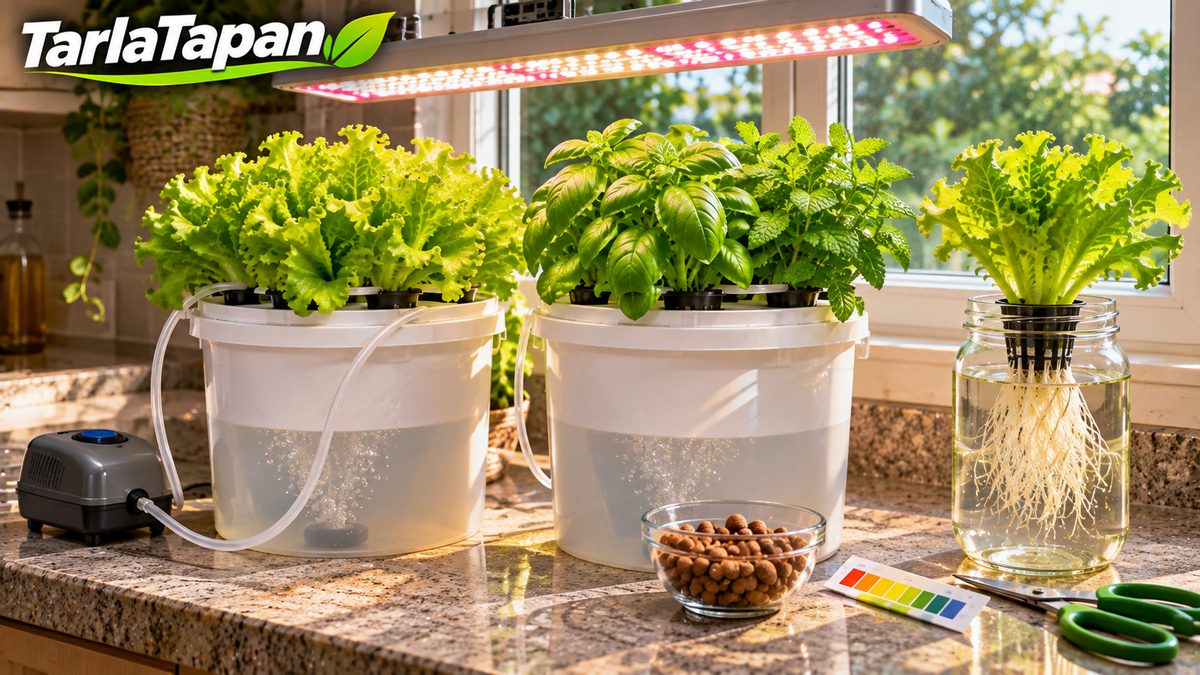
To grow vegetables hydroponically at home, you replace potting soil with fertilized water. A bucket or storage tote, a few net pots, a growing medium, a hydroponic fertilizer and light are enough to start. University of Minnesota Extension writes that hydroponics can be done indoors or outdoors, is space-efficient, uses less water than soil gardening, means no weeds and, with artificial lighting, works all year long.
This guide is for hobby growers: people without a garden who want their own lettuce and basil from a kitchen counter or balcony, and maybe cherry tomatoes in summer. If you are curious about larger systems, see how to start a vertical farm.
Contents
- What do you need for hydroponics at home?
- The easiest method: deep water culture in a bucket or jar
- Step-by-step: growing vegetables without soil at home
- What do you put in the water? Fertilizer and pH
- Which vegetables grow best hydroponically at home?
- How often should you change the water?
- Harvest and food safety
- Common beginner mistakes
What do you need for hydroponics at home?
Home hydroponics needs six things: plants, a container that holds water, a way to anchor the plants, nutrients, light and clean water. UMN Extension lists these as the basic parts of any hydroponic setup.
| Item | Purpose | Tip for hobby growers |
|---|---|---|
| Bucket or tote with lid | Water and nutrient tank | Food-safe, opaque plastic |
| Net pots | Hold the seedlings | Sit in holes in the lid |
| Growing medium | Supports roots | Clay pebbles, perlite, coconut coir, rockwool |
| Hydroponic fertilizer | Plant food | Ready mix for your crop |
| pH test strips | Measure acidity | Cheap, last for years |
| Light | Photosynthesis | Sunny south window or LED grow light |
| Aquarium air pump (optional) | Adds oxygen | Useful with several plants |
What replaces soil? The growing medium. According to UMN Extension, rockwool is the most popular medium; coconut coir holds water well and is a natural byproduct; clay pebbles allow good airflow and are reusable; perlite is cheap but light enough to float. Whatever you choose, the same source recommends soaking it in water for 24 hours and changing the water before use.
The easiest method: deep water culture in a bucket or jar
For beginners, the easiest method is deep water culture, where the plant sits in the lid and its roots hang into the water below. UMN Extension calls it the most common system for small-scale growers and the least expensive and easiest to maintain. A 5-gallon bucket or a plastic storage bin is enough.
The pump-free version is known as the Kratky method. As the plant drinks, the water level drops by itself, and the upper roots stay in the air, where they get oxygen. It needs no electricity and runs quietly on a kitchen counter. The one rule: according to UMN Extension, once roots develop, only one third to one half of them should be submerged.
The active version uses an aquarium pump and airstone to bubble air into the water. If plants of different sizes share one container, the same source notes that aeration protects the roots of the shorter plant.
Step-by-step: growing vegetables without soil at home
Follow this order to grow vegetables hydroponically in a bucket or tote:
- Clean the container. Wash it with soapy water and rinse well.
- Cut the lid. Make holes the size of your net pots so the rim rests on the lid. Space them according to the mature size of the plant.
- Start the seeds. Sow seeds in rockwool or coconut coir starter cubes. UMN Extension recommends soaking the cubes first, keeping them partly submerged and transplanting when roots push through the bottom.
- Seedlings also work. If you started seedlings in soil or bought them, the same source says to rinse the soil off the roots before moving them into the system.
- Mix the nutrient water. Add fertilizer at the rate on the label, then test the pH.
- Place the seedlings. Put each one in a net pot and fill around it with clay pebbles or perlite. At first, the bottom of the pot should touch the water.
- Give light. Without a sunny window, use an LED grow light. UMN Extension's example calculation is for a small system with the light on 14 hours a day.
- Keep the water dark. Light on the water encourages algae; wrap clear containers.
Line up several containers on a shelf and you have a small vertical garden. For shelf setups, see types of vertical farming.
What do you put in the water? Fertilizer and pH
In hydroponics you add a hydroponic fertilizer that contains every nutrient the plant would otherwise get from soil. UMN Extension explains that plants need 17 nutrients and that only carbon, hydrogen and oxygen are naturally available in a hydroponic system. The rest, including nitrogen, phosphorus and potassium as well as calcium, magnesium, sulfur, iron, manganese, zinc, boron and others, must come from fertilizer.
Can you use regular garden fertilizer? It usually falls short, because trace elements are missing. The easiest route is a fertilizer made for hydroponics and for your crop. UMN Extension notes that there are mixes for hydroponic lettuce and for tomatoes, and that plants with different needs should be kept in separate containers. If lettuce and kale need the same dose, they can share one.
pH rules are simple:
- Target: UMN Extension says plants do best in water with a pH of 5.4 to 7.
- When to test: Test tap water as it comes out and after adding fertilizer; in a small system, every few weeks after that is enough.
- If pH is low: Add a little baking soda.
- If pH is high: Use a food-grade acid such as citric acid.
- Hard water: Water that leaves crust on faucets pushes pH up; test it more often.
Which vegetables grow best hydroponically at home?
The easiest vegetables to grow hydroponically at home are leafy greens and kitchen herbs. UMN Extension writes that lettuce, herbs and brassicas such as mustards and kale grow well year-round, and that Swiss chard and amaranth also work well. In summer, tomatoes, cucumbers, strawberries and peppers can be grown hydroponically outdoors.
| Vegetable | Difficulty | When | Note |
|---|---|---|---|
| Lettuce | Very easy | Year-round | Harvest in 6-7 weeks |
| Arugula | Very easy | Year-round | Regrows after cutting |
| Basil, mint, parsley | Easy | Year-round | Cut 3-5 times |
| Spinach | Easy | Cool months | Bolts in heat |
| Swiss chard, kale | Easy | Year-round | Long harvest |
| Cherry tomatoes | Medium | Summer, outdoors | Choose a container variety |
| Strawberries | Medium | Summer, outdoors | Drip or tower system |
| Peppers, cucumbers | Hard | Summer, full sun | Need lots of light and a big container |
| Potatoes, carrots, onions | Not suitable | — | Root and tuber crops |
UMN Extension notes that heat-loving crops like tomatoes, cucumbers and peppers can be grown indoors with extra heat and light, but that this would be cost-prohibitive for most gardeners. For them, it recommends varieties labeled "grows well in pots" or "container variety". For a tomato, choose a container roughly the size of the mature plant's canopy.
For why some crops work and others do not, see what can you grow in a vertical farm.
How often should you change the water?
For short crops you can often reach harvest without changing the water; for long crops, replace it fully once or twice per season. UMN Extension writes that the "set it and forget it" approach should only be practiced for short-lived crops such as lettuce, which can be harvested in 6 to 7 weeks.
| When | Task |
|---|---|
| Daily | Check leaves, roots and water level |
| When water drops | Top up with nutrient water at label strength |
| Every few weeks | Test pH |
| Long crops like tomatoes | Replace all the water once or twice per season |
| After each harvest | Wash and sanitize containers and pots |
When topping up, add nutrient water, not plain water. In UMN Extension's example, if the label says one teaspoon per gallon, every new gallon gets one teaspoon. Do not pour used nutrient water down the drain; the same source suggests giving it to a garden or houseplant.
Harvest and food safety
Lettuce and herbs can be cut several times, while head lettuce is harvested once. According to UMN Extension, most herbs and leaf lettuce can be harvested repeatedly by cutting the most mature, lowest leaves, and most growers harvest 3 to 5 times before starting over.
Hydroponic water is warm and full of nutrients, so microbes can multiply quickly. The same source recommends:
- Wash your hands before touching any part of the system.
- Harvest with clean scissors into a clean container.
- When pulling roots, keep water from splashing onto edible leaves.
- Rinse produce thoroughly before eating.
- After harvest, scrub the container with detergent and sanitize with 1 tablespoon of household bleach per gallon of water; let it air dry without rinsing.
Common beginner mistakes
Most beginners make the same mistakes:
- Submerging all the roots: Roots run out of air and rot. Keep about half in the air.
- Leaving soil on seedlings: Soil clouds the water and carries microbes. Rinse roots.
- Using houseplant fertilizer: Trace elements are missing and leaves yellow.
- Skipping pH tests: Nutrients are in the water but the plant cannot use them.
- Using clear containers: Algae grows in water that sees light.
- Bringing in outdoor plants: Aphids and thrips come too. See vertical farming pests and diseases.
- Starting with tomatoes: Lettuce and basil are the safest first crops.
Frequently Asked Questions
What is the easiest vegetable to grow hydroponically?
The easiest vegetables to grow hydroponically are lettuce, arugula, basil and mint. They are short, fast-growing and do not need much light. Lettuce can be harvested in 6 to 7 weeks.
What vegetables can not be grown hydroponically?
Root and tuber crops such as potatoes, carrots and onions are poor choices for home hydroponics. Fruiting crops like peppers and cucumbers can be grown, but indoors they need costly extra light and heat. Leafy greens and herbs are the reliable choice.
Can I use regular plant food in a hydroponic system?
Regular plant food is usually not enough for a hydroponic system. In water, plants also need calcium, magnesium, iron and other trace elements that soil normally supplies. A fertilizer made for hydroponics contains all of them.
What do you put in water for hydroponics?
For hydroponics you put a hydroponic fertilizer into the water at the rate shown on the label. Then you check that the pH is between 5.4 and 7, as UMN Extension recommends. Top up with nutrient water, not plain water, as the level drops.
Does home hydroponics need electricity?
Home hydroponics does not always need electricity. The Kratky method uses no pump, and a sunny window can replace a lamp. Indoors and in winter, an LED grow light helps, and an air pump is useful when several plants share a container.
TarlaTapan guides focus on practical, field-tested growing advice. Corrections and suggestions are welcome at info@tarlatapan.tr.