Do Vertical Farms Make Money? Costs and Profit Explained
Do vertical farms make money? Cost items from building, racks and LEDs to electricity and labor, how to calculate lamp power costs, when vertical farms turn a profit and a checklist.
Do vertical farms make money? Some do, but only when three conditions meet: a high-value crop, cheap electricity and a buyer lined up before the first harvest. When one of the three is missing, the numbers rarely work. The German agricultural information centre BZL states that vertical farming saves land, water and fertilizer but, because of high energy and technology costs, is not yet profitable for many crops.
There is no single price for a vertical farm; a balcony shelf and a warehouse farm differ a hundredfold. Online quotes are usually vendor offers that age quickly. Instead of a ready figure, this article gives you a way to calculate your own costs and profit. For the basics, see what is vertical farming.
What costs go into a vertical farm?
Vertical farm costs fall into two groups: one-time setup costs and monthly operating costs.
| Setup costs | Operating costs |
|---|---|
| Building, container or warehouse fit-out | Electricity (lamps, pumps, HVAC) |
| Racks and channels | Fertilizer and pH adjusters |
| LED lamps | Seeds and starter cubes |
| Pumps, tanks, tubing | Water |
| HVAC, dehumidifiers, ventilation | Labor |
| Automation and sensors | Packaging and delivery |
| Generator or backup power | Replacing lamps and equipment |
USDA ARS notes that vertical farming's high costs are often discouraging, but that shipping containers and abandoned warehouses are readily available and relatively inexpensive. A grower who already owns a building removes one of the biggest setup items.
How to calculate electricity costs
Electricity cost is lamp power (watts) times daily hours times days, converted to kilowatt-hours and multiplied by your rate. Every grower can run this with their own tariff.
UMN Extension gives a worked example for a small system:
- Lamp power: 9 watts
- Daily run time: 14 hours
- Annual run time: 14 × 365 = 5,110 hours
- Annual use: 9 × 5,110 = about 46 kilowatt-hours
According to the same source, at 12 cents per kilowatt-hour (a common U.S. price in 2020), this small system costs about $5.44 a year in electricity. Multiply 46 kWh by your own rate to adapt it.
That example is a one- or two-bucket home system. A commercial rack has dozens of lamps, and in some farms they run around the clock; BZL reports that the large farm in England lights its crops 24 hours a day. Do not forget to add the power of pumps, air conditioning and dehumidifiers. USDA ARS stresses that humidity control requires expensive and energy-intensive HVAC systems.
Lamp and equipment replacement
Leave out lamp life and the cost will be wrong. According to UMN Extension, LED lamps last about 25,000 hours. At 14 hours a day, that is roughly four years and ten months.
A simple rule:
- Divide total lamp cost by expected years of life.
- Add the result to annual costs.
- Do the same for pumps, sensors and HVAC.
When do vertical farms turn a profit?
Vertical farms turn a profit only when a high-value crop, cheap electricity and a reliable buyer come together.
BZL writes that vertical farming pays mainly for high-priced, fast-growing leafy vegetables such as lettuce and herbs, and that most seasonal produce can still be grown much more cheaply in greenhouses or fields. Grow Magazine agrees: because of high building, lighting and management costs, vertical farms only make sense for high-value crops that do not need much light.
That is why crop choice is half of the profit calculation. See what can you grow in a vertical farm for suitable crops.
Profit calculation step by step
Run your own profit estimate in this order:
- Rack capacity: How many plants fit per rack? According to UMN Extension, a table-top NFT system holds 36 plants.
- Harvests per year: If lettuce is ready in 6 to 7 weeks, how many cycles fit in a year per shelf?
- Sellable output: Subtract losses from disease, spoilage and unsold product.
- Price: Use the price your buyer will pay you, not the supermarket shelf price.
- Revenue: Sellable output × your price.
- Costs: Electricity + fertilizer + seed + labor + packaging + delivery + depreciation.
- Result: Revenue − costs.
Then run a bad-case scenario: a power price increase, one rack lost to disease, one buyer leaving. If you still break even in the bad case, the investment is safer.
Small scale versus large scale
The difference between a home system and a commercial farm is not just the number of racks. At home a window, a plug and a bucket are enough, while a commercial site multiplies every item and adds new ones.
- Home scale: Costs are mostly lamps, fertilizer and seed. The effect on the power bill is small.
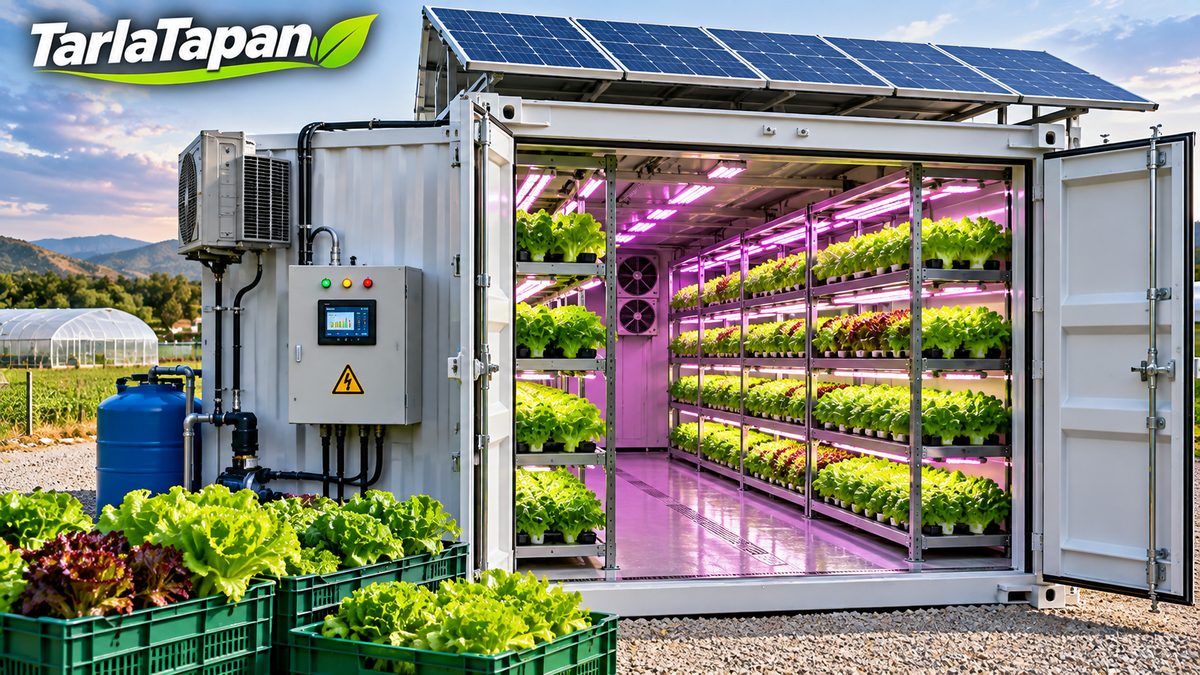
- Container scale: The shell is ready, but insulation, HVAC and a power connection are needed.
- Warehouse scale: HVAC, dehumidification, automation, backup power and labor come in. Fixed costs grow.
Unit costs may fall as you scale, but every empty rack is a loss. Growing capacity in step with buyers is the safest path.
How to cut vertical farming costs
The most effective ways to cut vertical farming costs are producing your own energy, using an existing building and choosing the right crop.
- Solar panels: BZL writes that in hot, dry regions vertical farming with solar power can be very sensible. The large farm in England also draws its electricity from solar energy.
- Reusing lamp heat: In the same farm, waste heat from the LEDs warms the room.
- Existing buildings: Empty barns, warehouses or containers. USDA ARS notes they are cheap and easy to find.
- Sunlight plus LED: Using a sunlit structure with supplemental LEDs instead of a fully closed room lowers power use. Grow Magazine notes that heating a greenhouse is still cheaper than lighting an equivalent vertical farm.
- Start small: Begin with a few racks and grow once you have buyers.
- Hygiene: Every lost rack raises costs directly. See vertical farming pests and diseases.
Checklist before you invest
Can you answer yes to all of these?
- Do I have at least one regular buyer for my produce?
- Have I calculated my power rate and monthly consumption?
- Is my building ready, or does it need construction?
- Do I have backup power for outages?
- Do I have the know-how or an advisor for pH, nutrients and hygiene?
- Do I avoid losses even in the bad-case scenario?
If not, start with a trial at home or in a small room. The setup steps are in how to start a vertical farm. Grant and loan programs for controlled environment agriculture change from year to year, so check current terms with your local agricultural extension office before applying.
Frequently Asked Questions
How much does it cost to start a vertical farm?
The cost to start a vertical farm varies enormously with scale. A one- or two-shelf home system needs only a few lamps and containers, while a warehouse farm needs a building, HVAC and automation. A reliable figure requires a quote based on your building, rack count and power rate.
What is the biggest cost in vertical farming?
The biggest cost in vertical farming is electricity. BZL notes that despite LED technology, power costs are so high that production pays only for high-priced vegetables. Lamps, pumps and climate control make up most of the bill.
Is vertical lettuce farming profitable?
Vertical lettuce farming can be profitable with a regular buyer and a fair power price. Lettuce is ready in 6 to 7 weeks, so a shelf allows many cycles per year. Its price per pound is lower than herbs, so the calculation must be done carefully.
How much electricity does a vertical farm use?
A vertical farm's electricity use depends on lamp wattage, hours and number of lamps. In UMN Extension's example, a 9-watt lamp running 14 hours a day uses about 46 kilowatt-hours a year. Commercial farms use many more lamps for longer hours, plus climate control.
Why have some vertical farms failed?
Some vertical farms have failed because electricity and setup costs outran their revenue. BZL explains that most seasonal produce is still much cheaper to grow in greenhouses or fields. Farms that grew low-value crops or expanded before securing buyers were most exposed.
TarlaTapan guides focus on practical, field-tested growing advice. Corrections and suggestions are welcome at info@tarlatapan.tr.