What Does Walnut Blight Look Like? Symptoms, Spraying and Control in Australia
What does walnut blight look like? Symptoms on leaves, catkins and nuts, why fungicides fail, copper spraying, when to prune walnut trees and prevention.
What Does Walnut Blight Look Like? Walnut blight is the most damaging walnut disease in Australia. It is caused by a bacterium that infects leaves, shoots, flowers and young nuts. Wet weather in spring spreads it fast. Infected nuts often drop early or have stained, poor-quality kernels. This guide explains how to recognise the disease and how growers control it.
What is walnut blight?
Walnut blight is a bacterial disease of walnut trees, caused by Xanthomonas arboricola pv. juglandis. The bacteria survive in buds and old infected tissue. In spring, rain splashes them onto new leaves, catkins and young nuts.
The disease is found in walnut regions around the world. In Australia, it has been studied mainly in Tasmania and, more recently, in the Riverina.
Symptoms of walnut blight
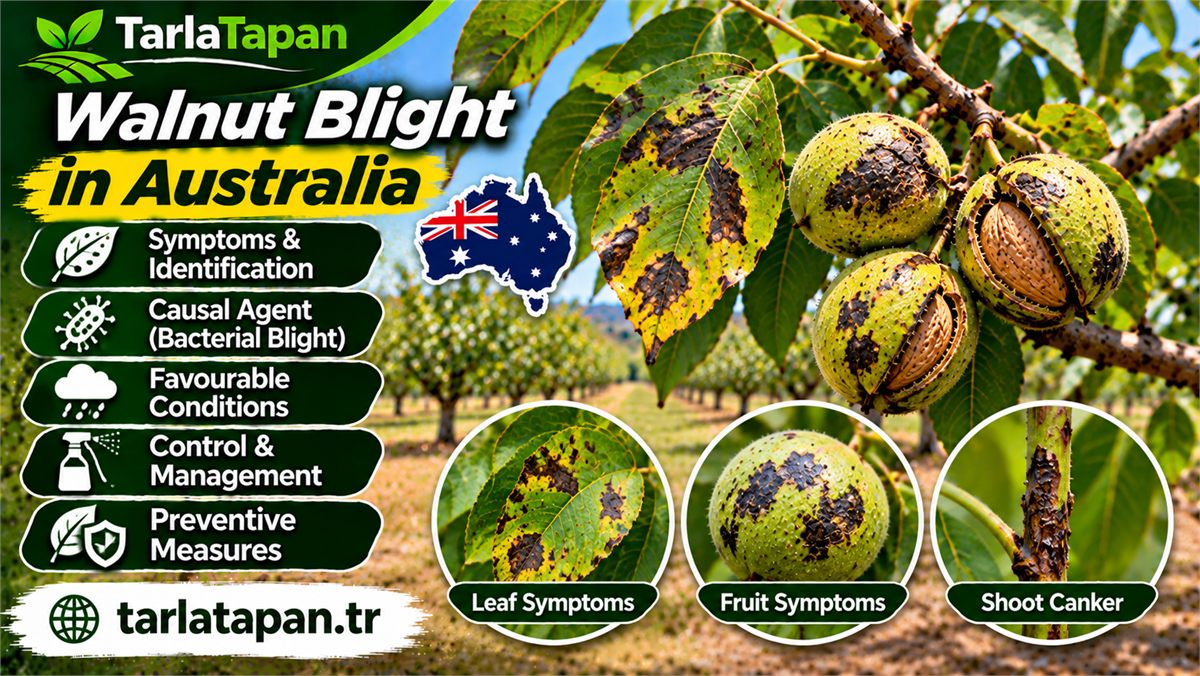
- Leaves: small dark spots, often with a yellow edge. Spots can join and distort the leaf.
- Shoots: black, sunken spots on young green shoots.
- Catkins and flowers: blackened catkins and dead female flowers.
- Young nuts: black spots on the green hull. Early infections often make the nut drop.
- Older nuts: black patches that can spread through the shell and stain the kernel.
Black hulls late in summer can also come from sunburn, so check the pattern. Blight usually starts as small, distinct spots.
Why rain makes walnut blight worse
Rain in the weeks after budburst is the main trigger. Research in Tasmania found that the level of disease was linked to the amount of rain in the first four weeks after budburst. In one dry year, two copper sprays a week apart gave good control. In a wetter year, up to nine sprays failed to control it.
This means the same spray program can work well one year and poorly the next. Wet springs need closer attention.
How to control walnut blight
Copper-based sprays are the main control for walnut blight in Australia. Many growers use copper, often mixed with mancozeb, starting at budburst. Sprays are repeated every 7 to 14 days or before rain while new growth is exposed.
Start early. A 2024–25 trial at Leeton in the Riverina compared programs that began at different times. Programs starting at budburst reduced disease the most, from about 71% of nuts infected in unsprayed trees to about 40%. Programs that started after budburst and stopped before flowering gave almost no benefit.
Always follow the product label and local advice. Copper rates and timing differ between products and regions.
Problems with copper sprays
Copper is becoming less reliable. A current Australian research project led by the University of Queensland notes that copper sprays are becoming less effective, costly and harmful to the environment. Researchers are studying copper and mancozeb resistance in the bacteria and testing other controls.
Heavy, repeated copper use can also build up in the soil. Use the lowest effective rate and only spray when the risk is real.
Preventing walnut blight
- Choose late-leafing varieties: Chandler and Franquette leaf out later, after much of the spring rain.
- Prune for airflow: an open canopy dries faster after rain.
- Avoid overhead watering: sprinklers that wet the canopy help spread bacteria.
- Remove infected material: prune out blackened shoots and pick up infected nuts.
- Keep trees healthy: well-fed, well-watered trees cope better.
For backyard trees, a copper spray at budburst and again before forecast rain in early spring is often enough in dry years.
For more walnut care, read growing walnut trees in Australia and best walnut varieties for Australia.
What does walnut blight look like?
Walnut blight shows up as small, dark brown to black spots on leaves, catkins, green shoots and young nuts. On nuts, the spots grow into black, sunken patches, and infected nuts often drop early or have blackened, shrivelled kernels.
Leaf spots are often surrounded by a yellow halo. Infected catkins turn black and wither. Symptoms appear first after wet, mild weather during spring, when the tree is flowering and setting nuts.
Can walnut blight be treated with fungicide?
No, walnut blight is caused by a bacterium, Xanthomonas arboricola pv. juglandis, not a fungus, so ordinary fungicides do not control it. Copper-based sprays are the main chemical option because copper also acts against bacteria.
Copper must be on the plant before infection, so it is used as a protective spray from bud burst through the main flowering and early nut-set period, especially before forecast rain. It cannot cure spots that are already visible. Always follow the label and current registration for walnuts in your state, and be aware that repeated copper use can lead to resistant bacteria.
When should you cut back a walnut tree?
Walnut trees are best pruned in dry weather in late summer or early autumn, after harvest and before leaf fall. Pruning then reduces sap bleeding and the risk of infection through wounds.
Avoid pruning in late winter and spring, when walnuts bleed heavily and blight bacteria spread easily in wet weather. Remove dead, diseased and crossing branches and disinfect tools between cuts on infected trees. Burn or remove blighted prunings rather than leaving them under the tree.
Which walnut varieties are less affected by blight?
Late-leafing varieties usually suffer less from blight, because they flower after the wettest spring weather. Early-leafing varieties are more exposed.
No variety is fully resistant. In wet regions, choose a later-leafing variety, plant in an open, airy spot and avoid overhead irrigation during spring.
More Australian Walnut Guides
- Growing Walnut Trees in Australia
- How Much Water Does a Walnut Tree Need
- Best Walnut Varieties for Australia
- Where Do Walnuts Grow in Australia?
Frequently Asked Questions
What causes black spots on walnuts?
Black spots on green walnut hulls are most often caused by walnut blight, a bacterial disease spread by rain in spring. Sunburn can also blacken exposed nuts in summer. Blight spots usually start small and distinct.
When should you spray walnut trees for blight?
Spray for walnut blight starting at budburst, then repeat every 7 to 14 days or before rain while new growth appears. Research at Leeton showed programs starting at budburst worked best.
Can walnut blight be cured?
Walnut blight cannot be cured once tissue is infected, but it can be controlled. Copper sprays protect new growth, and pruning out infected shoots reduces the bacteria. Control focuses on prevention in spring.
Does walnut blight kill the tree?
Walnut blight rarely kills a mature tree. It damages leaves, shoots and nuts, and can sharply reduce the crop. Repeated severe attacks weaken young trees.
Which walnut varieties resist blight?
No walnut variety is fully resistant. Late-leafing varieties such as Chandler and Franquette often escape the worst infection because they leaf out after much of the spring rain.
TarlaTapan guides focus on practical, field-tested growing advice. Corrections and suggestions are welcome at info@tarlatapan.tr.