Which Walnut Variety Is Best for Australia? Chandler, Howard and More
Which walnut variety is best for Australia? Chandler, Howard, Franquette and backyard choices compared for flavour, blight and climate, plus other nut trees.
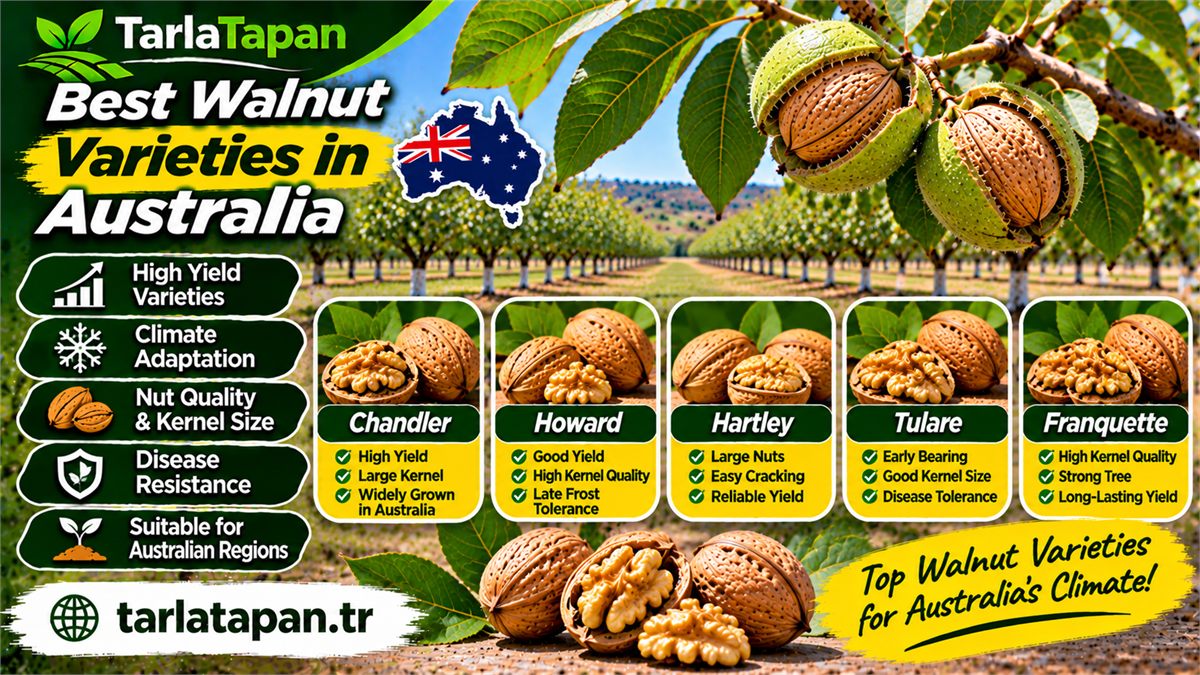
Which Walnut Variety Is Best for Australia? The best walnut varieties for Australia are Chandler and Howard for orchards, and compact types such as Serr for backyards. In frost-prone areas, late-leafing varieties such as Chandler and Franquette are safer. This guide compares the main varieties grown here and explains how to choose one for your climate.
Main walnut varieties grown in Australia
Chandler and Howard are the predominant walnut varieties grown in Australia today. Other varieties found in Australian orchards include Franquette, Hartley, Vina, Serr and Lara.
| Variety | Leafing time | Tree size | Notes |
|---|---|---|---|
| Chandler | Late | Large (about 10–12 m) | Light, high-quality kernels; main commercial variety |
| Howard | Mid to late | Medium | Productive; common in orchards |
| Franquette | Very late | Large | Older variety; good where spring frost is common |
| Hartley | Mid | Large | Older variety with large nuts |
| Serr | Early | Small to medium | Good backyard choice |
| Lara | Mid | Medium | Grown in Tasmania |
Chandler
Chandler is the leading commercial walnut in Australia. It is a late-leafing variety, which helps it avoid spring frost and some walnut blight. It produces light-coloured kernels that sell well. Chandler grows into a large tree, listed at about 10 to 12 metres tall and 8 to 10 metres wide. NSW government climate work uses Chandler as its reference walnut.
Howard
Howard is the other main orchard variety. It is productive and widely planted with Chandler. Its medium size makes it easier to manage than older large varieties.
Franquette and older varieties
Franquette was the dominant walnut in Australia for many years. Until the late 1980s, it made up about 70% of walnut trees planted. It leafs out very late, which makes it useful in frosty areas such as parts of Tasmania. Some Tasmanian orchards grow Franquette alongside Chandler.
Hartley and Vina are other older varieties still found in some orchards and backyards.
Best walnut varieties for backyards
For a backyard, choose a grafted tree of a named variety. Serr is a good choice because it grows into a small to medium tree. Chandler gives excellent nuts but needs a lot of space.
Walnuts are partly self-fertile, so one tree can crop alone. Planting two varieties that flower at the same time improves pollination and yield.
Choosing a walnut for your climate
- Frost-prone areas: pick late-leafing varieties such as Chandler or Franquette.
- Warmer areas with less winter chill: walnut chill needs range roughly from 400 to 1,500 hours. Ask your nursery for a lower-chill variety.
- Wet springs: late-leafing types often escape the worst walnut blight.
- Small gardens: choose a compact variety such as Serr.
NSW government climate work suggests low-chill walnut varieties may become more useful as winter chill declines in some regions.
Grafted vs seedling walnut trees
Always choose grafted trees if you want reliable nuts. Grafted walnuts usually start bearing three to five years after planting. Seedling trees can take 10 to 15 years, and their nuts often differ from the parent tree.
For planting and care, see growing walnut trees in Australia, and for disease control, see walnut blight in Australia.
Where to buy walnut trees
Buy walnut trees from a specialist fruit and nut nursery or a good local garden centre. Winter is the main season for bare-root grafted trees, which are often cheaper than potted ones. Check the label for the variety name, whether it is grafted, and its chill and leafing time before buying.
Which walnut variety has the best flavour?
Flavour depends more on freshness and kernel colour than on variety, but light-coloured kernels from varieties such as Chandler are prized for their mild, sweet taste. Darker kernels usually taste more bitter.
Kernel colour is affected by heat and water stress at the end of summer. Well-watered trees in a mild climate produce lighter, sweeter kernels. Freshly harvested Australian walnuts in autumn often taste noticeably better than imported nuts that have been stored for months.
What are the most successful nut trees to grow in Australia?
The most successful nut trees in Australian gardens depend on climate: macadamias in warm, frost-free coastal areas, almonds in hot, dry regions, and walnuts, chestnuts, hazelnuts and pecans in areas with cold winters.
| Nut | Best climate | Notes |
|---|---|---|
| Macadamia | subtropical, frost-free | native to Australia, large evergreen tree |
| Almond | hot, dry summers, mild winters | flowers early, sensitive to spring frost |
| Walnut | cool winters, warm summers | large tree, needs deep soil and water |
| Chestnut | cool, higher rainfall | acid soils, popular in Victoria |
| Hazelnut | cool, moist | shrub-sized, needs a pollinator |
| Pecan | long, hot summers | very large tree, slow to crop |
What are the best types of walnuts to eat?
The best walnuts to eat are fresh, light-coloured kernels from the current season, stored cool and sealed. English or Persian walnuts (Juglans regia) are the type sold for eating.
Black walnuts (Juglans nigra) have a much stronger flavour and very hard shells. In Australia they are grown mainly for high-value timber rather than nuts. Buy in-shell walnuts if you want them to keep longer, and store kernels in the fridge or freezer.
Do you need two walnut trees for nuts?
Walnuts are self-fertile, but a single tree often sets fewer nuts because its male catkins and female flowers may not open at the same time. Planting a second variety with overlapping flowering usually improves the crop.
Ask your nursery which pollinator suits your main variety. In large orchards, growers plant pollinator rows for this reason. In a backyard, a neighbour's walnut within a few hundred metres can also help, because walnut pollen travels on the wind.
More Australian Walnut Guides
- Growing Walnut Trees in Australia
- Where Do Walnuts Grow in Australia?
- When to Harvest Walnuts in Australia
- Walnut Blight in Australia
Frequently Asked Questions
What is the most popular walnut variety in Australia?
Chandler is the most important commercial walnut variety in Australia, followed by Howard. Chandler is late leafing and produces light, high-quality kernels.
Which walnut tree is best for a small garden?
Serr is a good walnut for a small garden because it grows into a small to medium tree. Buy a grafted tree for faster cropping. Standard varieties such as Chandler need much more space.
Are walnut trees self-pollinating?
Walnut trees are partly self-fertile, so one tree can produce nuts. Planting two varieties that flower at the same time usually gives a bigger crop.
What walnut variety is best for frost-prone areas?
Late-leafing varieties such as Chandler and Franquette are best for frost-prone areas. They start growing later in spring, after most frosts have passed.
How many chill hours do walnuts need?
Walnut chill needs vary widely by variety, roughly from 400 to 1,500 hours below 7°C. Check the label or ask the nursery before buying a tree for a mild climate.
TarlaTapan guides focus on practical, field-tested growing advice. Corrections and suggestions are welcome at info@tarlatapan.tr.