What Are the Four Types of Kangaroos? Red, Grey and Antilopine Compared
What are the four types of kangaroos? Red, eastern grey, western grey and antilopine compared, plus wallabies, wallaroos, tree-kangaroos and the rarest species.
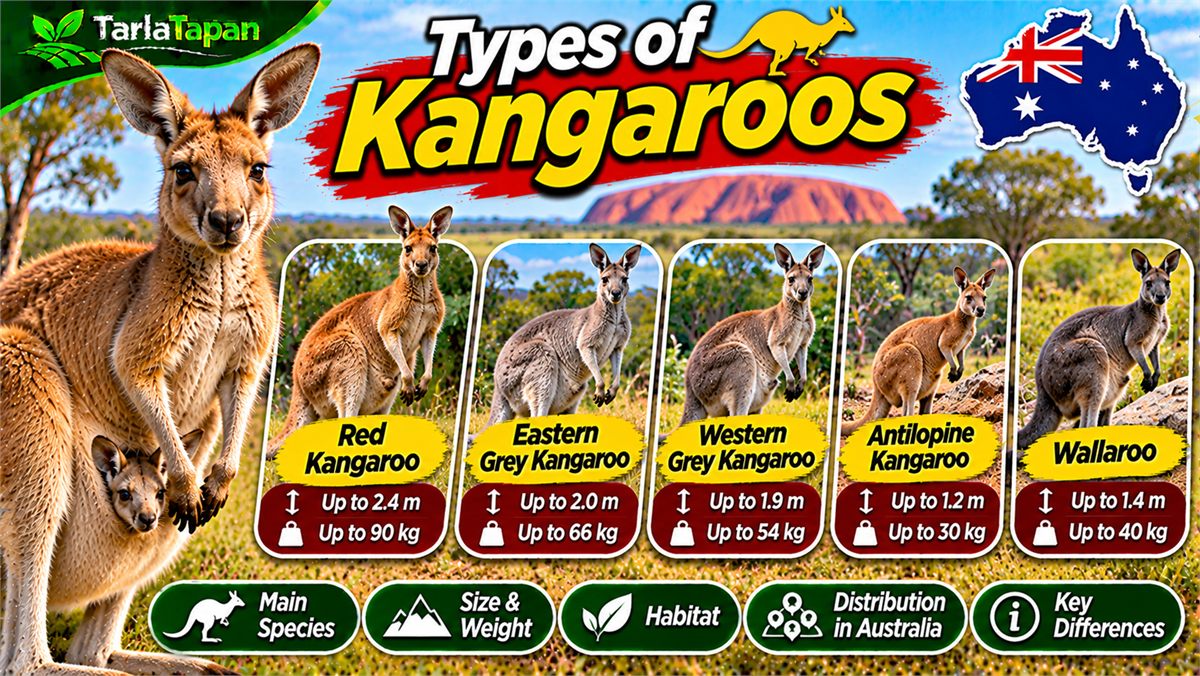
What Are the Four Types of Kangaroos? There are many types of kangaroos and their relatives, but four large species are usually called the true or great kangaroos: the red, eastern grey, western grey and antilopine kangaroo. They differ in size, colour and where they live. This guide explains how to tell them apart and how they relate to wallabies and wallaroos.
The four great kangaroos
| Species | Fur colour | Habitat | Size |
|---|---|---|---|
| Red kangaroo | Males reddish, females blue-grey | Dry inland plains | Largest |
| Eastern grey kangaroo | Silver-grey | Eastern woodlands and grasslands, Tasmania | Very large |
| Western grey kangaroo | Brown-grey, darker face | Southern and western Australia | Large |
| Antilopine kangaroo | Reddish-tan | Tropical northern woodlands | Smallest of the four |
Red kangaroo
The red kangaroo is the largest kangaroo and the largest living marsupial. It lives across the dry interior of Australia, on open plains and in arid shrublands. Males usually have reddish fur, while many females are blue-grey, which is why females are sometimes called "blue fliers".
Reds have a black and white mark on the side of the muzzle. They are heavily muscled and can travel long distances to find fresh grass after rain.
Eastern grey kangaroo
The eastern grey kangaroo is the kangaroo most people see near farms, golf courses and towns in eastern Australia. It lives in grassy woodlands from Queensland to Victoria and in Tasmania. Big males are about as tall as red kangaroos but are less heavily built.
Eastern greys have soft silver-grey fur and a pale belly. They often graze in large mobs at dawn and dusk.
Western grey kangaroo
The western grey kangaroo lives across southern Australia, from Western Australia to western Victoria and New South Wales. Its fur is browner than the eastern grey's, with a darker face. Adult males have a strong smell, which has earned them the nickname "stinker".
Its range overlaps with the eastern grey in some areas. The two are sometimes seen feeding together but do not interbreed.
Antilopine kangaroo
The antilopine kangaroo lives in the tropical woodlands of northern Australia, including parts of the Northern Territory, Queensland and Western Australia. It is the smallest of the four great kangaroos and has reddish fur. It is adapted to a wet-dry tropical climate rather than the dry inland.
Kangaroos vs wallabies vs wallaroos
All three belong to the same family, the macropods. The main difference is size and build:
- Kangaroos: the largest macropods, with long legs suited to open country.
- Wallaroos: stocky, medium-sized macropods often found in rocky hills.
- Wallabies: smaller macropods, usually with more compact bodies.
Tree-kangaroos are a separate group that live in rainforest trees in north Queensland and New Guinea.
Kangaroos in Tasmania
Only one of the great kangaroos lives in Tasmania: a subspecies of the eastern grey, often called the Forester kangaroo. It is the largest native mammal on the island and lives mainly in the north-east and central grasslands.
How to tell kangaroos apart
- Colour: reddish males point to red or antilopine kangaroos; silver-grey suggests an eastern grey; brown-grey suggests a western grey.
- Face: red kangaroos have a black and white muzzle stripe; western greys have a darker face.
- Location: inland desert plains suggest reds; tropical north suggests antilopines.
For more about kangaroo life, see our main kangaroo facts guide and what kangaroos eat.
How many types of kangaroo are there?
There are four large kangaroo species, but the wider kangaroo family of macropods includes more than 60 species. These include wallabies, wallaroos, pademelons, tree-kangaroos and quokkas.
Macropod means "big foot" and refers to the long hind feet that all members of the family share. Most live only in Australia, while some species are also found in New Guinea and nearby islands. Close relatives are the smaller bettongs and potoroos, often called rat-kangaroos.
What are the smaller kangaroos called?
Smaller members of the kangaroo family are usually called wallabies. Even smaller relatives are pademelons, bettongs, potoroos and the musky rat-kangaroo.
| Group | Typical size | Where you see them |
|---|---|---|
| Wallabies | medium, often under 20 kg | bushland, rocky areas, coastal scrub |
| Wallaroos | stocky, between wallaby and kangaroo | rocky hills and ranges |
| Pademelons | small, compact | rainforest edges, Tasmania |
| Bettongs and potoroos | rabbit-sized | forests, mostly at night |
| Quokka | small, round face | Rottnest Island, south-west WA |
There is no strict scientific line between a kangaroo and a wallaby. The names mainly describe size, so large species are called kangaroos and smaller ones wallabies.
What is the rarest type of kangaroo?
None of the four large kangaroo species is rare, but several smaller members of the family are threatened. Some rock-wallabies, the bridled nailtail wallaby and tree-kangaroos in New Guinea are among the most at risk.
Their main threats are foxes and feral cats, loss of habitat and fire. In contrast, red and grey kangaroos are widespread and their numbers can even rise in good seasons, because farm dams and pastures give them extra water and food.
Tree-kangaroos
Tree-kangaroos are kangaroos that live in trees. In Australia they are found only in the rainforests of far north Queensland, where Lumholtz's and Bennett's tree-kangaroo live.
They have strong front limbs, short hind legs and a long tail for balance. Unlike ground kangaroos, they can move their hind legs independently, which helps them walk along branches. They are rarely seen because they are shy and live high in the canopy.
Do kangaroos live outside Australia?
Wild kangaroos of the four large species live only in Australia. Some smaller relatives, such as tree-kangaroos and certain wallabies, are also native to New Guinea and nearby islands.
Small introduced populations of wallabies exist in places like New Zealand, Hawaii and parts of Britain, descended from escaped or released animals. Outside these cases, kangaroos are seen abroad only in zoos and wildlife parks.
More Kangaroo Guides
- Kangaroo Facts
- What Do Kangaroos Eat?
- Kangaroo Joey and the Pouch
- Kangaroos and Farmers in Australia
Frequently Asked Questions
How many types of kangaroos are there?
Four large species are usually called kangaroos: the red, eastern grey, western grey and antilopine kangaroo. Many smaller relatives, such as wallabies and wallaroos, belong to the same family.
What is the difference between a red and a grey kangaroo?
Red kangaroos are more heavily muscled, live in dry inland areas and have a black and white muzzle stripe. Grey kangaroos live in wetter woodlands and grasslands and have grey or brown-grey fur.
Are female red kangaroos red?
Not usually. Many female red kangaroos are blue-grey, while males are reddish. This colour difference is why females are sometimes called "blue fliers".
What is the smallest kangaroo?
Of the four great kangaroos, the antilopine kangaroo is the smallest. Smaller members of the family, such as wallabies, are not usually called kangaroos.
Is a wallaby a kangaroo?
A wallaby is a close relative of the kangaroo in the same family, the macropods. Wallabies are smaller and more compact, while kangaroos are the largest members of the family.
TarlaTapan guides focus on practical, field-tested growing advice. Corrections and suggestions are welcome at info@tarlatapan.tr.