What Are Some Interesting Facts About Kangaroos? Species, Diet, Joeys
What are some interesting facts about kangaroos? How far they jump, if they sleep, why they cannot walk backwards, species, diet and joeys.
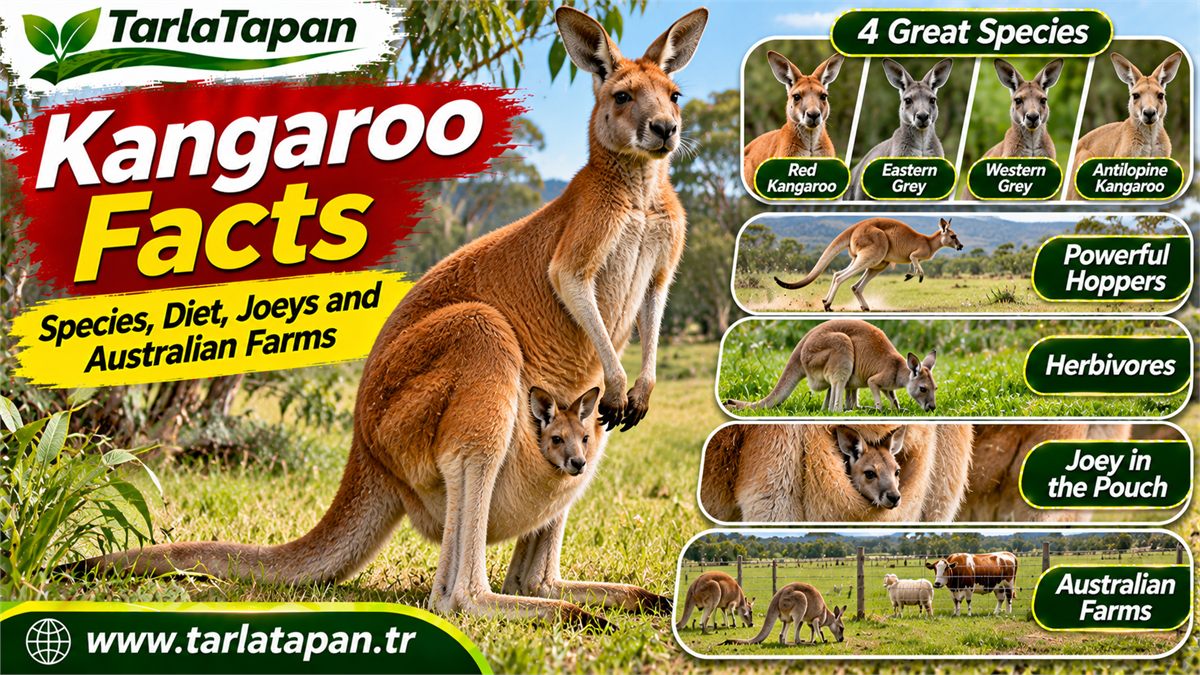
What Are Some Interesting Facts About Kangaroos? Kangaroo facts start with one simple point: kangaroos are marsupials found only in Australia and nearby New Guinea, and they are the national symbol of Australia. They carry their young in a pouch, move by hopping on powerful back legs and live mostly on grass. This guide covers the main species, how kangaroos move, what they eat, how joeys grow and why kangaroos matter to Australian farmers.
Contents
- What is a kangaroo?
- Types of kangaroos
- How big are kangaroos?
- How kangaroos hop
- What kangaroos eat
- Kangaroo babies: joeys and the pouch
- Kangaroo behaviour and mobs
- Kangaroos and Australian farms
What is a kangaroo?
A kangaroo is a large marsupial in the macropod family, a name that means "big foot". Marsupials give birth to tiny, undeveloped young that finish growing in a pouch. The macropod family also includes wallabies, wallaroos and tree-kangaroos.
In everyday use, "kangaroo" usually means the largest members of the family. Smaller relatives are generally called wallabies, but the difference is mainly one of size.
Types of kangaroos
There are four main species of large kangaroo, often called the great kangaroos:
| Species | Where it lives | Notes |
|---|---|---|
| Red kangaroo | Dry inland Australia | Largest kangaroo and largest living marsupial |
| Eastern grey kangaroo | Eastern Australia, Tasmania | Common near farms and towns |
| Western grey kangaroo | Southern and western Australia | Brown-grey fur, overlaps with eastern greys |
| Antilopine kangaroo | Tropical north | Smallest of the four |
Read our full guide to the types of kangaroos.
How big are kangaroos?
Male red and eastern grey kangaroos are the biggest. Large males can stand close to 2 metres tall when upright and weigh well over 60 kg. Females are much smaller, often around half the weight of a big male.
Red kangaroos are similar in height to eastern greys but are more heavily muscled. Antilopine kangaroos are the smallest of the great kangaroos.
How kangaroos hop
Kangaroos are the only large animals that move mainly by hopping. Their long back feet and strong tendons act like springs, storing energy at each landing and releasing it on the next jump. This makes hopping very efficient at speed.
When grazing, kangaroos move slowly on all fours and use their strong tail as a fifth leg. The tail also helps them balance while hopping. They cannot walk backwards easily, which is one reason the kangaroo appears on the Australian coat of arms as a symbol of moving forward.
What kangaroos eat
Kangaroos are herbivores. The large species are mainly grazers that eat grasses, along with some herbs and shrubs. Their diet changes with the seasons. Studies of red kangaroos found they eat more broad-leaved herbs after rain, but in severe drought grass made up most of their diet.
Kangaroos digest tough plants by fermenting them in a large, chambered stomach, a little like cattle and sheep but simpler. They are also very good at saving water. One study found red kangaroos used only a small fraction of the water that sheep needed. See what kangaroos eat.
Kangaroo babies: joeys and the pouch
A baby kangaroo is called a joey. Red kangaroos are pregnant for only about 33 days. The newborn is tiny, about the size of a jellybean, and crawls on its own into the mother's pouch, where it attaches to a teat.
The joey stays in the pouch for many months, usually around 8 to 11 months depending on the species. Female kangaroos can also pause the development of a new embryo while an older joey is still feeding. Read more in our guide to kangaroo joeys and the pouch.
Kangaroo behaviour and mobs
Kangaroos live in groups called mobs. A mob can range from a few animals to dozens. Large males compete for females by "boxing": standing on their tails, wrestling and kicking with their back legs.
Most kangaroos are active at dawn, dusk and night, and rest in shade during the heat of the day. This is why many road collisions happen at dusk and after dark.
Kangaroo body and senses
A kangaroo's body is built for open country. Large, upright ears can turn independently to pick up sounds from different directions, and eyes set high on the side of the head give a wide field of view for spotting danger. When a mob senses a threat, kangaroos often thump the ground with their back feet as a warning.
The tail is thick and muscular. When a kangaroo moves slowly while grazing, it plants its tail and front paws on the ground and swings its back legs forward, so the tail works almost like an extra leg. Strong front paws with claws are used for grooming, holding food, digging shallow holes for water and, in males, wrestling.
Where kangaroos live
Kangaroos are found across almost all of mainland Australia and in Tasmania, but each species has its own home range. Red kangaroos favour the open plains and shrublands of the arid centre. Eastern greys prefer grassy woodland along the eastern side of the continent, where rainfall is higher. Western greys occupy the southern half of the country from Western Australia to western New South Wales. Antilopine kangaroos stay in the tropical savanna of the far north.
Most kangaroos need a mix of open grass for feeding and trees or shrubs for daytime shade. That combination is why they gather on farm paddocks next to bushland, along road verges and on golf courses near towns.
Lifespan and predators
Most wild kangaroos live a good deal shorter lives than kangaroos kept in sanctuaries and zoos, where food, water and vet care are reliable. Young joeys face the highest risk, especially in droughts when mothers cannot produce enough milk.
The main natural predator of adult kangaroos is the dingo. Wedge-tailed eagles and foxes can take joeys. Today, droughts, vehicles and disease cause many more deaths than predators.
Are kangaroos dangerous?
Kangaroos usually avoid people, but large males can be dangerous, especially where they have been fed and lost their fear of humans. A male may stand tall, cough or growl, and then kick with its powerful back legs and sharp claws.
If a kangaroo looks threatening, back away slowly, keep low and avoid eye contact. Do not turn your back and run, and never try to feed or touch a wild kangaroo. Dogs should be kept on a lead, because kangaroos can injure or drown dogs that chase them into water.
Kangaroos and road safety
Kangaroos are one of the most common animals involved in vehicle collisions in rural Australia. They are most active at dawn, dusk and night, and often move in mobs, so where you see one there are often more. Slow down in kangaroo country at these times, especially near water and grassy verges.
Kangaroos as a national symbol
The kangaroo is one of Australia's best-known symbols. It appears with the emu on the national coat of arms, on coins, on the tail of the national airline and in the logos of many sporting teams and products. For First Nations peoples, kangaroos have long been an important source of food, skins and tools, and they feature in many stories and ceremonies across the continent.
Where to see kangaroos
The best way to see kangaroos is in the wild, at dawn or dusk, in national parks and reserves with open grassy areas. Many campgrounds and country golf courses also have resident mobs. Wildlife sanctuaries let you see different species up close and learn how injured animals and orphaned joeys are cared for. Always watch from a distance and never feed wild kangaroos. Quiet, slow movement and a pair of binoculars will give you the best view without disturbing the mob.
Kangaroos and Australian farms
Kangaroos are protected native animals, but in many farming areas their numbers are high. Farmers often see them as competitors for pasture and water with sheep and cattle, especially in dry years. Kangaroos can also damage fences and crops.
States manage kangaroo numbers through surveys, permits and commercial harvest quotas. In New South Wales, the 2024 commercial harvest was about 544,000 kangaroos, reported as around 5.6% of the estimated population in the managed zones. Read our guide to kangaroos and farmers in Australia.
How far can a kangaroo jump?
A large red or grey kangaroo can cover around eight metres in a single bound and clear fences close to two metres high. Over short distances they can reach speeds of more than 50 km/h.
The secret is in the tendons of the hind legs. They stretch like springs when the kangaroo lands and release the energy on the next hop. That is why hopping becomes more efficient the faster a kangaroo moves, while a running animal of the same size would tire quickly.
Do kangaroos ever sleep?
Yes, kangaroos sleep for several hours a day, mostly during the hottest part of the day. They rest in the shade of trees and shrubs and become active again in the late afternoon, at night and in the early morning.
A sleeping kangaroo often lies on its side or sits propped up on its tail. Members of a mob take turns being alert, so the group is rarely caught off guard. This daily rhythm is one reason why kangaroos are so often seen on roads at dusk and dawn.
Why can't kangaroos walk backwards?
Kangaroos cannot easily move backwards because of their large tail and the shape of their powerful hind legs. Their body is built for moving forward in big hops.
When grazing slowly, a kangaroo uses a five-legged walk: it balances on its front paws and tail and swings both hind legs forward together. This makes the tail work like a fifth limb. The inability to walk backwards is often mentioned as one reason the kangaroo and the emu appear on the Australian coat of arms, as symbols of a nation moving forward.
Where does the word kangaroo come from?
The word kangaroo comes from the Guugu Yimithirr language of far north Queensland. Its speakers used a word recorded as gangurru for a type of large grey kangaroo.
The word was noted down during James Cook's voyage in 1770 near today's Cooktown. A popular myth claims kangaroo meant "I don't understand", but linguists have shown this is not true. Many other Aboriginal languages have their own names for the different kangaroo species.
Do some kangaroos really climb trees?
Yes, tree-kangaroos live in the rainforests of far north Queensland and New Guinea and spend most of their lives in trees. Australia has two species, Lumholtz's and Bennett's tree-kangaroo.
They have shorter hind legs, strong front arms and curved claws for gripping bark. Their long tail helps them balance on branches. Tree-kangaroos are shy, active mainly at night and much harder to see than grey or red kangaroos.
All Kangaroo Guides
- Types of Kangaroos
- What Do Kangaroos Eat?
- Kangaroo Joey and the Pouch
- Kangaroos and Farmers in Australia
- Kangaroo Meat Dishes
Frequently Asked Questions
Where do kangaroos live?
They are found on mainland Australia and in Tasmania, with related tree-kangaroos and wallabies in New Guinea. Each species prefers a different landscape, from desert plains to tropical savanna.
What is the largest kangaroo?
The red kangaroo holds that title. It is also the biggest marsupial alive today, and mature males are powerfully built.
What do you call a baby kangaroo?
It is called a joey. Joeys of all marsupials share this name, from kangaroos to koalas and wombats.
What do kangaroos eat?
Their main food is grass. After rain they add soft herbs and new shoots, and in dry spells they browse shrubs.
Why are kangaroos culled in Australia?
Kangaroo numbers are managed in some areas because high populations compete with livestock for pasture and water and can suffer in droughts. States set quotas based on population surveys.
TarlaTapan guides focus on practical, field-tested growing advice. Corrections and suggestions are welcome at info@tarlatapan.tr.