How to Grow Ginger at Home From a Store-Bought Root
How to grow ginger from a piece of root: choosing ginger, pre-sprouting, planting in pots or beds, watering, feeding, hilling, harvesting baby and mature ginger, and storing it.
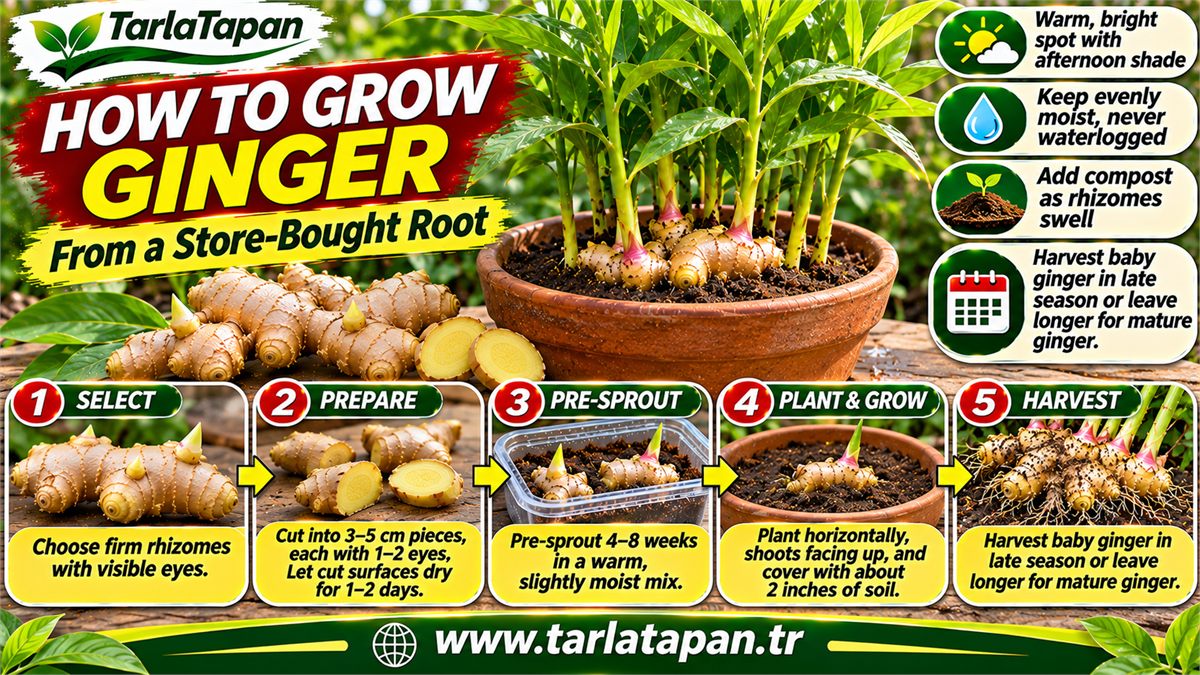
How to grow ginger, in short: take a firm, fresh piece of ginger root with visible "eyes" (growth buds), sprout it somewhere warm for a few weeks, then plant it horizontally a few inches deep in loose, rich soil once the soil is at least 50 °F (10 °C). Keep it warm, in partial shade, and evenly moist but never waterlogged. Ginger cannot survive frost, so outside the tropics it is usually grown in a pot, a greenhouse or a hoophouse, or planted out only for the warm months.
Ginger (Zingiber officinale) is not really a root but an underground stem called a rhizome. According to the U.S. National Center for Complementary and Integrative Health (NCCIH), ginger is native to the warm parts of Asia and is now also grown in South America, Africa and the Middle East. Treat it like the tropical plant it is and it will reward you.
The good news is that even short summers are enough. The Maine Organic Farmers and Gardeners Association (MOFGA) has documented farmers in Maine growing ginger successfully, and this guide turns their practice into steps for pots, balconies and backyard beds.
Table of Contents
- Can I grow ginger from a piece of ginger?
- How do you pre-sprout ginger?
- When should you plant ginger?
- How do you grow ginger in a pot?
- How do you plant ginger in the garden?
- How do you water and feed ginger?
- How long does ginger take to grow?
- Can you grow ginger in water?
- How do you store homegrown ginger?
Can I grow ginger from a piece of ginger?
Yes, you can grow ginger from a piece of ginger, including a root from the grocery store, as long as it is plump, firm and has visible eyes. Every shoot grows from one of those small yellowish buds; a piece without an eye will not sprout.
You have two options:
- Seed ginger: pieces sold specifically for planting by garden centers or seed suppliers. This is the most reliable choice. MOFGA describes Maine farmers ordering seed ginger grown in Hawaii.
- Grocery store ginger: fresh ginger from the store can sprout too. Some of it has been stored for a long time or treated, so it may be slow or refuse to sprout. Pick the freshest, firmest piece with the most obvious eyes; organic ginger is a popular choice.
Cut large rhizomes into pieces 1 to 2 inches (3 to 5 cm) long, each with one or two eyes. Let the cut surfaces dry for a day or two to reduce the risk of rot. Many gardeners soak store-bought pieces overnight in lukewarm water before sprouting them.
How do you pre-sprout ginger?
Pre-sprouting means keeping ginger warm and slightly moist for several weeks before planting. In cool regions with short summers, it is the single most useful step, because ginger grows slowly at first.
On the Maine farm described by MOFGA, the growers laid the pieces horizontally in a single layer in seedling trays with drainage holes, covered them with potting mix, and kept them at 75 °F (about 24 °C) in an insulated, heated box. The ginger stayed there for four weeks and then finished sprouting on a greenhouse bench. Their seed supplier recommends a soilless mix such as coir (cocopeat) for pre-sprouting.
At home:
- Fill a shallow tray with moist coir or seed-starting mix.
- Lay the ginger pieces flat with the eyes facing up and cover them with about an inch of mix.
- Put the tray in a constantly warm spot, such as on top of the refrigerator or near a heater.
- Keep the mix moist but not wet. Cold, wet ginger rots.
- Within a few weeks, green, bamboo-like shoots appear.
Be patient. One Maine grower quoted by MOFGA was sure his crop would amount to nothing because it was so slow to establish; it did most of its growing late in the season and still produced a good harvest.
When should you plant ginger?
Plant ginger outdoors when the soil is at least 50 °F (10 °C) and there is no more risk of frost. Start pre-sprouting four to eight weeks earlier, which in most temperate regions means March or April.
In Maine, according to MOFGA, ginger arrived in mid-March, was pre-sprouted for several weeks and was planted into a hoophouse in early June. In warmer zones you can plant earlier. If you grow in a pot, the calendar is flexible: start indoors and move the pot outside once nights are reliably warm, then bring it back in before autumn chills.
How do you grow ginger in a pot?
To grow ginger in a pot, use a wide, moderately deep container with drainage holes and loose, rich potting mix, and keep it somewhere warm and partly shaded. Rhizomes spread sideways more than downward, so width matters more than depth.
Container: at least 12 inches (30 cm) across; a long window box works well for several pieces.
Soil: ginger hates waterlogged soil but is a heavy feeder. Combine good potting mix with plenty of compost. Lighten heavy mixes with perlite.
Planting: add a few inches of mix, lay the sprouted pieces flat with shoots up, and cover with a couple of inches of mix.
Light: ginger likes warmth and brightness but not harsh afternoon sun. MOFGA reports that in a long hot spell in the southeastern U.S., under-watered plants withered and recovered only with shade cloth and extra water. Morning sun and afternoon shade is ideal.
Topping up: when the rhizomes swell and their pink "shoulders" break the surface, add a few inches of compost or mix. This is the pot version of hilling.
How do you plant ginger in the garden?
In the garden, ginger is planted in furrows much like potatoes and is hilled as it grows. MOFGA makes exactly this comparison: like potatoes, ginger needs to be weeded and hilled.
The spacing used on the Maine farm:
| Step | Practice |
|---|---|
| Soil preparation | Work in compost |
| Furrow depth | 6 inches (about 15 cm) |
| Row spacing | 30 inches (about 75 cm) |
| In-row spacing | 5 inches (about 13 cm); a Kentucky farm planted 12 inches (about 30 cm) apart with excellent yields |
| Covering | A few inches of soil over the pieces |
| Hilling | 4 inches (about 10 cm) of soil once the pink shoulders show |
In a home garden you do not need to copy these figures exactly. A warm, sheltered corner with afternoon shade is enough for a few plants. Black plastic mulch or a simple low tunnel helps warm the soil in cool regions.
How do you water and feed ginger?
Water ginger regularly but moderately, keeping the soil moist without letting water stand. In the words of the seed supplier quoted by MOFGA, ginger "does not like wet feet but does like to be well watered," and you should not overwater it.
A Kentucky farm watered three times a week for most of the summer, but MOFGA stresses that every grower has to find the right schedule for their location and soil. In a pot, use the finger test: water when the top inch is dry.
Ginger is a heavy feeder. The supplier strongly recommends an organic fertilizer at each hilling, and says a second and third round of hilling and feeding will boost yields. The Maine farmer later concluded that his crop needed more fertility and probably more water than he gave it.
In practice: mix plenty of compost into the soil at planting and add a handful more each time you hill or top up. If you use a liquid feed, start at half the vegetable-garden rate.
How long does ginger take to grow?
Ginger takes a full warm season to grow: in Maine, ginger planted in early June was harvested as baby ginger from late September into October, according to MOFGA. Mature ginger with a thick, tan skin needs even longer in the ground, which is why it is a commercial crop mainly in warm regions.
There are two kinds of harvest:
- Baby ginger: the young, swollen rhizome with thin white skin and pink tips. It is tender, juicy and mild, and it does not keep long.
- Mature ginger: if baby ginger is cured, it becomes the golden-skinned ginger sold in stores.
Dig with a garden fork, getting as deep as you can under the plant. Trim off the roots and green tops and rinse the rhizome gently. The original seed piece is often still firm and usable.
What yield can you expect? MOFGA reports that the supplier's literature cites an average of 8 pounds harvested for every pound planted, while the Maine farm got about 3 to 1. Another grower reported 4 pounds per row foot. Heat, fertility and water make the difference.
In a pot you do not have to dig up the whole plant: push the soil aside, cut off a piece of rhizome and let the plant keep growing.
Can you grow ginger in water?
Ginger pieces will often sprout in a shallow dish of water, but they cannot produce a real crop there. Water has no nutrients, and ginger is a heavy feeder.
Use water only as a way to wake up a piece: once green shoots and small roots appear, move it into a pot of rich soil. Change the water every couple of days to stop it from going sour.
How do you store homegrown ginger?
Fresh ginger keeps for a short time in the refrigerator and for months in the freezer. MOFGA notes that the Maine growers froze the old seed pieces for their own kitchen.
- Refrigerator: unpeeled, wrapped in a paper towel, in a container in the crisper drawer.
- Freezer: whole, or grated into ice cube trays. Frozen ginger is easy to grate.
- Drying: thin slices dried in the shade or at low oven heat, ideal for tea.
- For next year: keep one or two healthy pieces somewhere warm and dry and sprout them again in spring.
Try your harvest in our fresh ginger tea recipes.
Is ginger good for you?
Ginger has been used in folk medicine since ancient times, but many health claims are not well supported. NCCIH says research shows ginger may help with nausea and vomiting associated with pregnancy, while most studies of ginger for motion sickness have not shown it to be helpful.
NCCIH lists possible side effects when ginger is taken by mouth, including abdominal discomfort, heartburn, diarrhea, and mouth and throat irritation. If you take any medicine, talk with your health care provider before using ginger or any other herbal product. Cooking with ginger is not the same as taking concentrated supplements.
Frequently Asked Questions
Can you plant a ginger root from the grocery store?
Yes, a ginger root from the grocery store can be planted if it is fresh, firm and has visible eyes. Some store ginger has been stored for a long time or treated and sprouts slowly. Soaking it overnight in lukewarm water and pre-sprouting it somewhere warm improves your chances.
How long does it take ginger to sprout?
Ginger usually sprouts within a few weeks in warm conditions. On the Maine farm described by MOFGA, pieces kept at about 75 °F (24 °C) for four weeks were either already sprouting or swollen and ready to sprout. In cool conditions it takes much longer.
Does ginger need full sun?
No, ginger does best with warmth and bright light but not harsh afternoon sun. Morning sun with afternoon shade is ideal. MOFGA reports that ginger stressed by long heat recovered with shade cloth and extra watering.
Can ginger survive winter outside?
Ginger cannot survive frost, so it will not overwinter outside in cold climates. Harvest it before the first frost or bring the pot into a warm room. You can also save a couple of healthy pieces and replant them in spring.
How deep do you plant ginger?
Plant ginger pieces horizontally and cover them with a few inches of soil. The Maine farm described by MOFGA planted into 6-inch-deep furrows and covered the pieces with a few inches of soil, then hilled with 4 more inches as the rhizomes swelled. In pots, about 2 inches of cover is enough.
TarlaTapan guides focus on practical, field-tested growing advice. Corrections and suggestions are welcome at info@tarlatapan.tr.